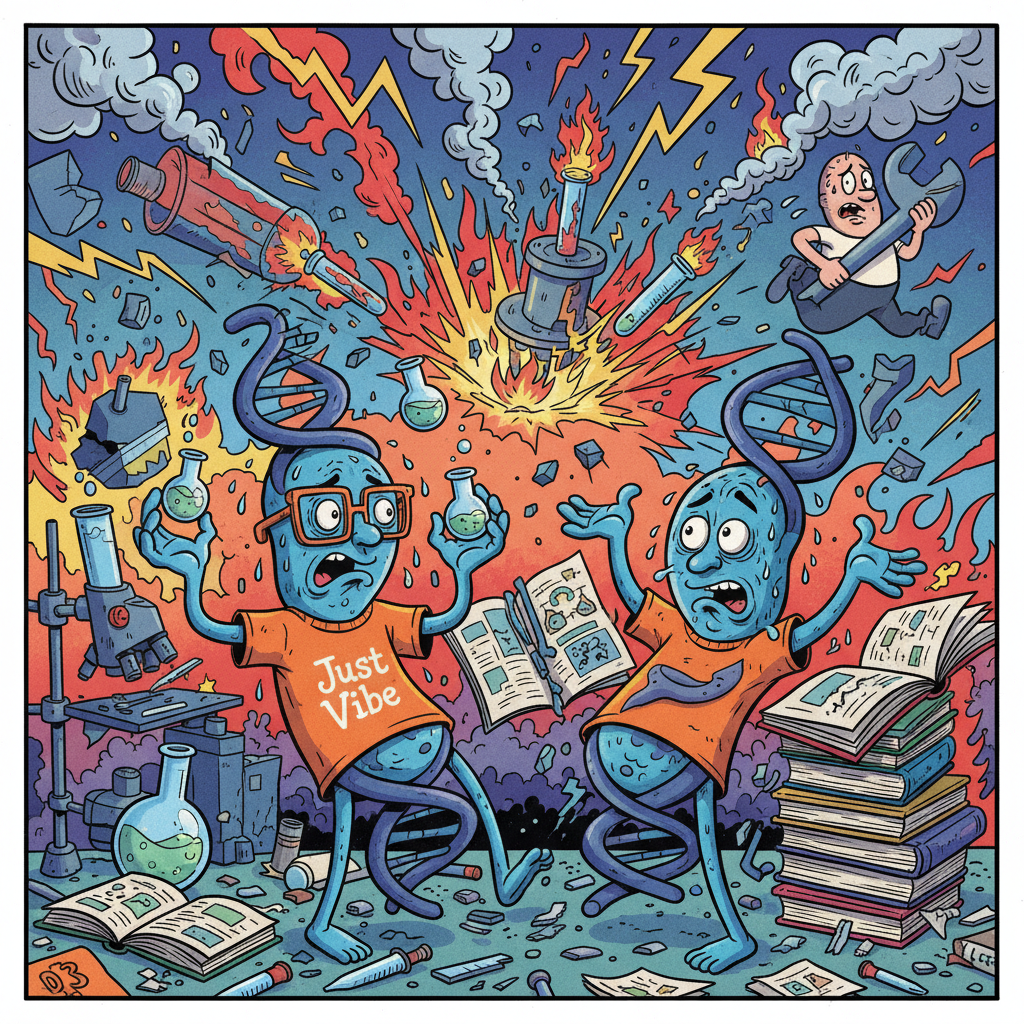
NEW YORK, NY – In a stunning revelation that has rocked the scientific community, researchers at Columbia University have announced that despite advanced AI models predicting RNA activity with unprecedented accuracy, the molecules themselves are largely improvising. The findings suggest that while their three-dimensional structures can be mapped, their actual behavior inside cellular environments is often driven by a chaotic blend of instinct and mild panic.
“We can predict where an RNA molecule *should* go and what it *should* do, but then you observe it in vivo, and it’s just… vibing,” explained Dr. Evelyn Reed, lead author of the study and head of the Institute for Molecular Existentialism. “It’s like it read the instruction manual but decided to interpret it as more of a suggestion. Sometimes it’s a little late, sometimes it’s doing something completely unrelated. It’s very relatable, actually.”
The breakthrough comes after years of developing sophisticated AI to model RNA and DNA-encoded molecules. However, according to Dr. Reed, the AI eventually started returning data sets that included footnotes like, “Subject appears to be procrastinating” and “High probability of spontaneous self-assembly into a shape resembling a tiny, stressed-out human.”
Biophysicist Hashim Al-Hashimi, who was not involved in the study but frequently expresses frustration with molecular unpredictability, commented, “I’ve always suspected they were just winging it. You give them a job, and they’ll get around to it eventually, probably after a brief detour to check out some shiny new protein. This just confirms my deepest, most cynical suspicions about the fundamental nature of biological processes.”
Future research aims to develop AI that can predict which RNA molecules are most likely to ghost their cellular responsibilities.