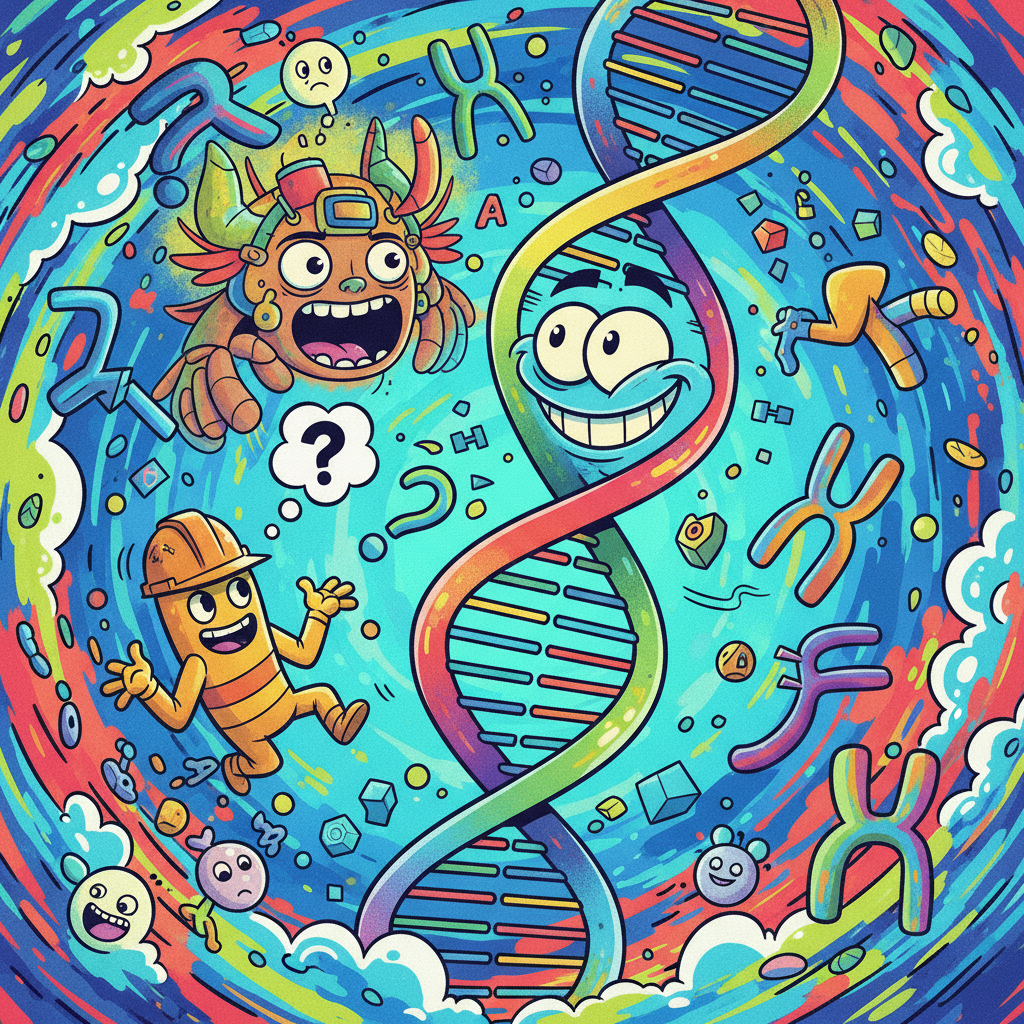
CARDIFF, WALES – In a groundbreaking study that has sent ripples of existential dread through the scientific community, researchers at Cardiff University have uncovered evidence that human DNA is no longer adhering to established genetic protocols, instead opting for what they term 'catastrophic chromosomal improvisation.' The process, dubbed chromoanasynthesis, involves telomeres breaking and reassembling in patterns so chaotic, scientists initially suspected a toddler had been given access to the genome sequencer.
“For years, we believed DNA replication was a meticulous, highly regulated dance,” explained lead researcher Dr. Greg Ngo, visibly shaken during a press conference. “Now, it appears our chromosomes are just throwing spaghetti at the wall to see what sticks. We’re talking about mutations so complex, they look like a Picasso painting designed by a committee of squirrels.”
Professor Duncan Baird, co-author of the study, elaborated on the implications. “This isn’t just a few typos; this is the genetic equivalent of a novel where every other paragraph is written in a different language, upside down, and occasionally just a recipe for sourdough. It suggests our fundamental building blocks might be experiencing some sort of biological mid-life crisis.”
Geneticists worldwide are now scrambling to understand why DNA has seemingly decided to abandon millennia of evolutionary precision in favor of what one anonymous expert called 'a series of increasingly unhinged genetic fan-fiction plots.' The findings are expected to revolutionize our understanding of inherited conditions and cancer, primarily by confirming that everything is, in fact, much worse than we thought.
Meanwhile, pharmaceutical companies have reportedly begun fast-tracking research into a new class of drugs designed to gently remind cells how to do their jobs.