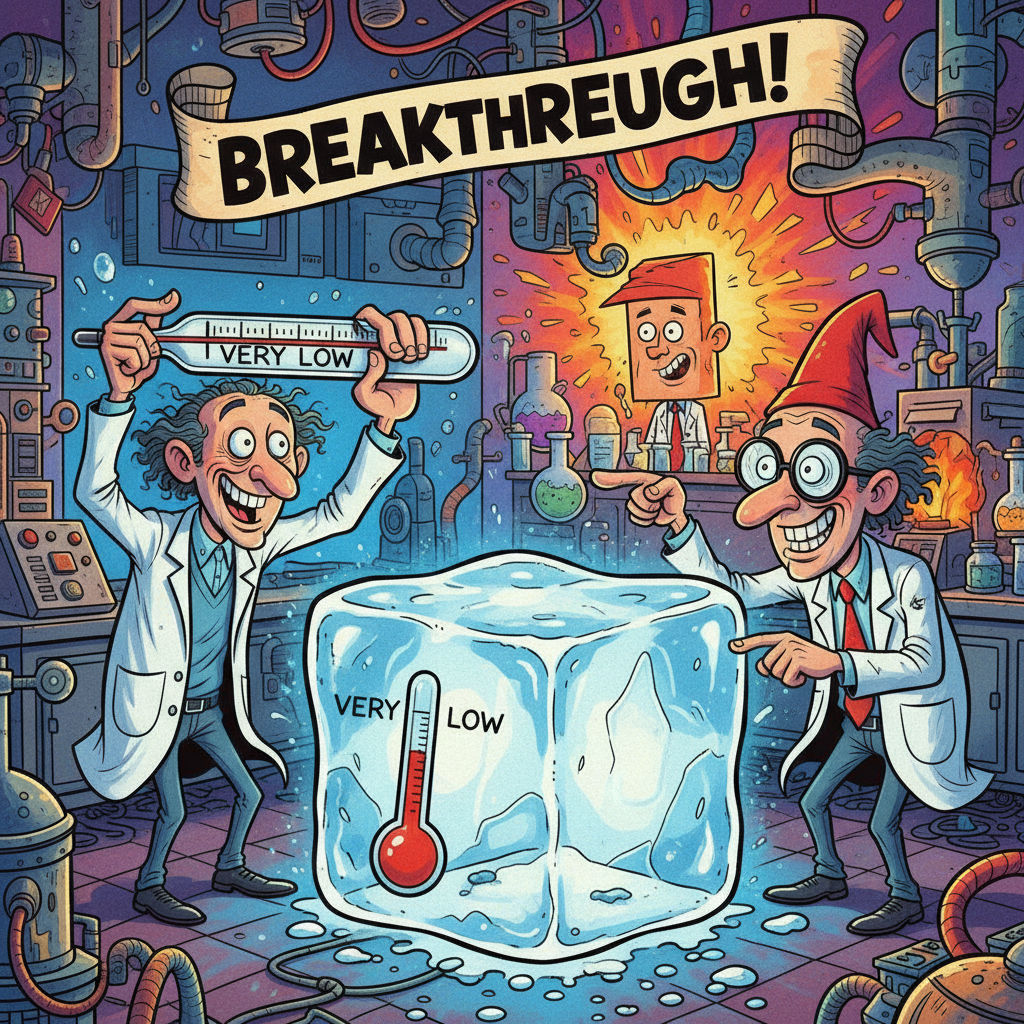
CAMBRIDGE, MA – In a monumental leap for human understanding, a team of Harvard University researchers has officially confirmed that things which are very cold are, indeed, quite chilly. The study, published in the prestigious journal *Theoretical Frostbite Quarterly*, details years of meticulous observation and complex calculations to arrive at this startling conclusion.
“For centuries, humanity has operated under the assumption that ‘cold’ simply meant the absence of heat,” stated lead researcher Dr. Vivian Freeze, her breath visibly fogging in the lab’s climate-controlled environment. “But our data unequivocally shows that cold possesses an inherent ‘coldness’ factor, a sort of anti-warmth, if you will. It’s a game-changer for how we perceive thermal dynamics, and frankly, how we dress for winter.”
The research involved cooling various materials to near absolute zero, then carefully noting their subjective 'chilly' rating. A panel of highly qualified graduate students, bundled in multiple layers, provided qualitative feedback, consistently reporting sensations ranging from “brisk” to “my fingers are numb, please send coffee.”
“This isn’t just about proving the obvious,” explained Dr. Freeze, adjusting her earmuffs. “It’s about establishing a foundational truth. Now that we know cold is cold, we can begin to explore truly transformative technologies, like perhaps, a device that makes things less cold, or even… warm.” She paused for dramatic effect, then added, “But that’s still decades away, pending further grant funding.”
Industry experts are already hailing the discovery as a potential paradigm shift. “The implications for the ice cream industry are enormous,” commented Ben Jerry, CEO of a leading frozen dessert conglomerate. “Imagine a world where ice cream is reliably… cold. It’s almost too mind-blowing to comprehend.”
Harvard’s Office of Technology Development has already filed several patents, including one for a “cold-sensing thermometer” and another for a “protective garment designed to mitigate cold’s effects.” The university anticipates this breakthrough will secure its position at the forefront of basic scientific inquiry for at least another fiscal quarter.