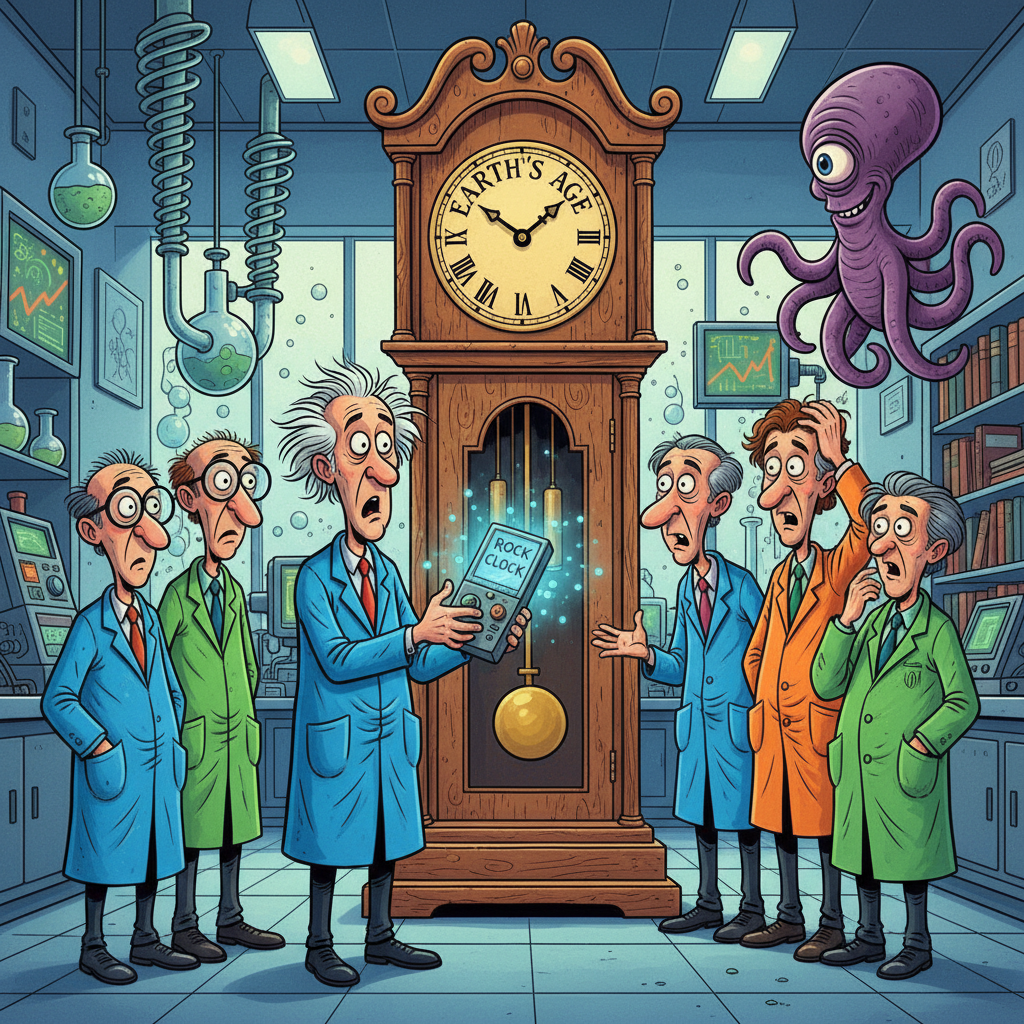
GENEVA – In a stunning development that has rocked the scientific community, researchers at the University of Lausanne have unveiled a new geological “rock clock” that confirms the Earth is, by all accounts, still incredibly ancient. The groundbreaking technology, detailed in *Nature Communications*, allows for the dating of major climate events from the dawn of complex animal life with unprecedented precision, ultimately concluding that the planet has not, in fact, gotten any younger.
“For years, we’ve operated under the assumption that Earth was old, but we lacked the definitive, hyper-accurate timestamp to truly put that theory to bed,” stated Dr. Evelyn Thorne, lead researcher and head of the Department of Chronological Redundancy. “This new rock clock, which utilizes a complex system of mineral decay and the occasional glancing at an actual sundial, finally provides the irrefutable evidence: it’s still billions of years old. Give or take a few million, which, let’s be honest, is basically nothing in the grand scheme of things.”
The team’s meticulous work involved analyzing ancient sediment layers and recalibrating existing geological models, a process Thorne described as “like resetting your microwave clock, but with rocks and a lot more grant money.” The findings are expected to have a profound impact on fields ranging from paleontology to geology, primarily by reaffirming everything they already believed.
“It’s a huge relief,” admitted Dr. Marcus Finch, a paleontologist not involved in the study. “Imagine if they’d found out the Earth was only, like, 300 years old. All those dinosaur bones would just be really old chickens.”
Experts say the next logical step is to develop a similar “rock clock” to determine if humanity has made any actual progress in the last decade.