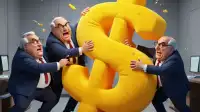

NEW YORK, NY – The nation’s real estate sector is reeling today after a groundbreaking, albeit perplexing, economic development. For the first time in recent memory, industry leaders and financial analysts are confronting the radical notion that money itself carries a cost, a concept now being colloquially referred to as 'interest rates.' This sudden shift has sent shockwaves through a market previously operating under the unexamined assumption of perpetual, frictionless capital acquisition.
Reports from major financial hubs indicate widespread bewilderment. "We're seeing an unprecedented correlation," stated Dr. Vivian Holloway, lead econometrician at the Institute for Novel Economic Anomalies. "Our preliminary models suggest that when the cost of borrowing capital increases, the demand for high-value assets, such as residential and commercial properties, tends to… well, decrease. It's a complex, almost counter-intuitive feedback loop we're calling the 'affordability paradox.'"
The phenomenon, which some are tentatively linking to actions taken by the Federal Reserve, has prompted a frenetic re-evaluation of long-held investment strategies. Property developers, who have enjoyed years of what one insider described as “capital on tap,” are now facing the harsh reality that lenders expect a return on their investment. “It’s like someone just told us gravity applies to houses,” lamented Sterling Price, spokesperson for Apex Global Properties, a leading developer of luxury micro-apartments. “All our projections were based on a zero-G 2. This… 'cost of money' thing… it adds a whole new layer of variables we hadn't accounted for.”
Financial media outlets, usually quick to pinpoint market drivers, have struggled to contextualize this novel economic force. Pundits on cable 2 programs are speculating wildly, with theories ranging from 'cyclical market adjustments' to 'the inherent price of time,' leaving everyday investors more confused than ever. Some analysts are even bravely suggesting that potential homebuyers might factor in monthly mortgage payments when considering a property purchase, a hypothesis currently undergoing rigorous peer review.
As the real estate market digests this astonishing revelation, economists warn that the 'cost of money' could become a recurring feature of the global financial landscape. Experts are now working tirelessly to determine if this 'interest' thing is a passing fad or a fundamental, albeit inconvenient, aspect of capitalism itself.
Hambry is a satire publication. All articles are works of fiction.