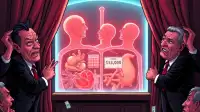
NEW YORK — Kalshi, the regulated prediction market, has permanently banned former U.S. Congressman George Santos, citing a conclusion that he likely engaged in insider trading. The decision marks the first time a prediction market has deemed an individual's future actions so inherently predictable in their criminality that they undermine the very concept of speculative risk.
"Our entire business model is built on predicting outcomes, analyzing probabilities, and allowing users to put their money on the line for uncertain events," stated Dr. Serena Vance, Kalshi's Chief Behavioral Economics Officer, in an internal memo obtained by Hambry. "Mr. Santos, however, presented a unique challenge. Our algorithms consistently predicted 'fraud' with 99.9% certainty across all his proposed trades, regardless of the underlying assets. It was less a prediction and more a diagnostic profile indicating a high propensity for creative accounting and legal gymnastics."
Sources within Kalshi indicate that Santos's trading patterns—or rather, the pre-cognitive certainty of his illicit intent—began to skew internal modeling, making legitimate speculation impossible. "When George Santos shows up, the 'will he commit fraud?' market effectively collapses," explained a senior data scientist who requested anonymity. "There’s no debate, no nuance, no actual *prediction* required. He makes our sophisticated machine learning look like a Magic 8-Ball that just says 'yes' to financial malfeasance every single time. It trivializes the entire enterprise."
The platform's ethical review board reportedly struggled with how to integrate Santos's data without creating an unfair advantage for other users, or frankly, exposing their own predictive limitations. "If you know someone is going to lie about their assets, defraud investors, or otherwise cheat, betting against them becomes less about market insight and more about patiently waiting for the inevitable," Dr. Vance elaborated in a follow-up interview. "This isn't 'prediction'; it's 'observational biology of a human grifter.' It takes all the nuanced fun out of it. We are a market of *uncertainty*, after all."
Kalshi ultimately concluded that Santos's participation was turning the nuanced art of forecasting into a mere exercise in documenting the predictable unraveling of one man's ethical framework. His mere presence on the platform, according to a leaked risk assessment, posed a "structural threat to market integrity by establishing too reliable a baseline for dishonesty." Essentially, the house couldn't reliably bet *against* Santos because his eventual wrongdoing was such a high-probability event, it became a statistical anomaly for a market built on doubt.
A Kalshi spokesperson, speaking on background, summed up the decision: "While our platform thrives on uncertainty, Mr. Santos’s consistent track record of self-enrichment and deception made accurate predictions of his next scam 'unforeseeably boring,' which frankly, is a bigger threat to market engagement than volatility."