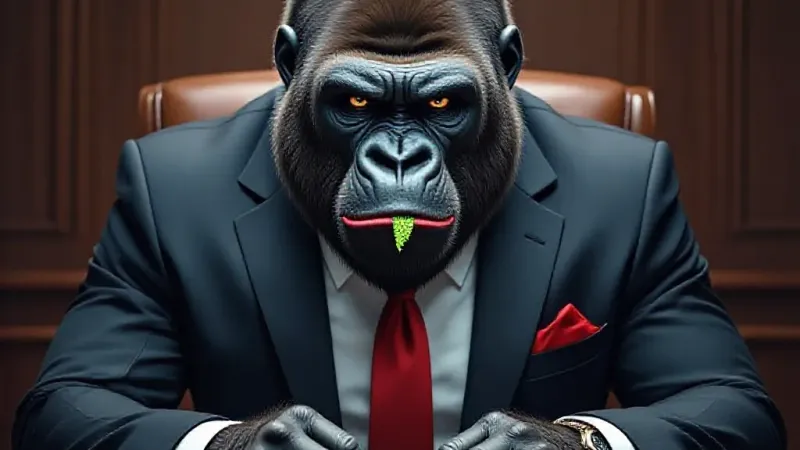
JAKARTA — In a move sending seismic ripples through global markets, Kweli, CEO of Gorilla, Inc., confirmed today his firm’s successful $125 million bond offering to fund an ambitious data center project in Indonesia. Speaking from his mahogany-paneled treehouse office, the silverback dismissed concerns about habitat destruction, stating his focus remains solely on optimizing quarterly returns for his shareholders.
"Frankly, the 'biodiversity' argument is just noise from legacy players who can't innovate," grunted Kweli, adjusting a tiny, custom-fit monocle over one eye. "My job is to identify underserved markets, leverage emerging technologies, and generate maximum value for our investors. If that means transforming a few thousand acres of prime rainforest into a next-gen, liquid-cooled server farm, then that’s a strategic imperative, not an ethical dilemma. We're talking petabytes of pure, unadulterated capital accumulation here."
Sources close to the company, primarily a family of highly caffeinated lemurs hired for their agile data entry and seed-dispersal skills, revealed Kweli’s intense, singular dedication to growth. "He once tore the arm off a venture capitalist who suggested we 'diversify into sustainable bamboo,'" whispered one terrified lemur, frantically typing on a miniature, solar-powered keyboard. "Said it diluted our core competency: raw, untamed market dominance and cloud infrastructure." The incident, which was swiftly settled out of court with a non-disclosure agreement and a lifetime supply of organic fruit, only solidified Kweli’s reputation as a hard-nosed, results-driven executive.
The bond offering, massively oversubscribed by institutional investors eager for "alpha growth in emerging markets," solidifies Gorilla, Inc.'s position as a formidable force in digital infrastructure. Analysts praised the company's "lean operational structure" and its vertically integrated supply chain, which allegedly includes direct procurement of rare earth minerals from uncontacted tribes and an innovative "banana-for-bandwidth" payment model, giving them an unfair advantage over human competitors often bogged down by cumbersome labor laws and environmental impact assessments.
Dr. Aris Chandra, a bewildered primate ethologist from the Institute for Anthropomorphic Corporate Studies, commented, "While I admire Kweli's business acumen, his relentless pursuit of capital seems to entirely bypass the inherent ecological consciousness one might expect from a great ape. It’s almost as if he’s adopted the most predatory aspects of human finance without any of the inconvenient guilt."
When pressed if his primate origins offered any unique insights into nature’s delicate balance, Kweli merely pounded his massive chest, rattling the expensive, abstract jungle art on his wall. "Balance? The only balance I care about is the balance sheet. And right now, it's weighted heavily towards growth, disruption, and an undeniable craving for more, bigger, faster data throughput to power AI models and NFT marketplaces. The jungle taught me one thing: only the strongest survive, and right now, the strongest have fiber-optic cables." The new data center, located squarely on former orangutan nesting grounds, is expected to be fully operational by Q3, promising to deliver unparalleled processing power and, presumably, even larger shareholder dividends.