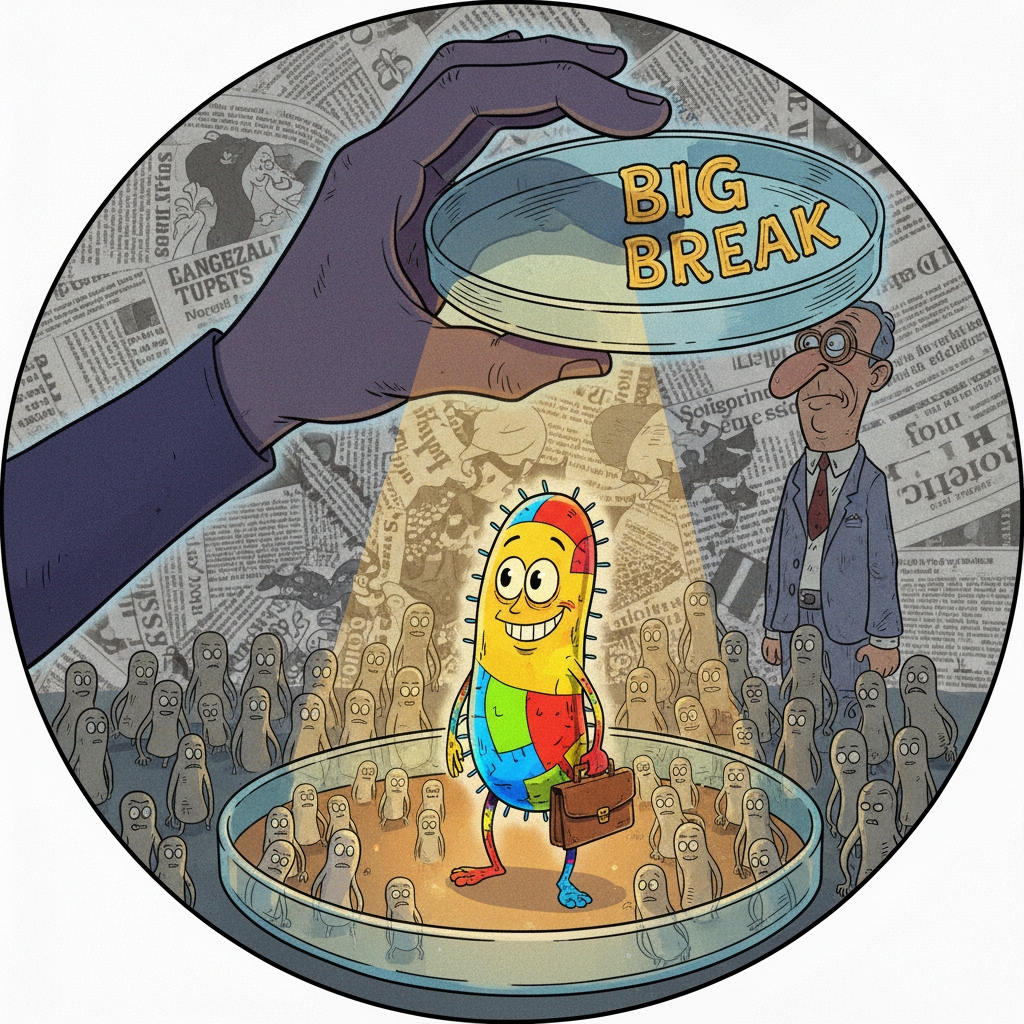
ZURICH – A groundbreaking new study from ETH Zurich and Queen Mary University of London has definitively proven that success, even at the microbial level, is less about consistent effort and more about sheer, dumb luck. The research, which analyzed how bacteria survive in nutrient-poor ocean expanses, concluded that these microscopic organisms thrive not through steady foraging, but by desperately clinging to existence until a 'rare, high-impact encounter' with a substantial food particle.
“We’ve essentially confirmed what every struggling artist, startup founder, and lottery ticket buyer already knew,” stated lead researcher Dr. Elara Vance. “The averages look terrible. Most of them are just drifting, barely alive. But that one bacterium that stumbles onto a whale carcass fragment? That’s the one that makes it, reproduces, and inspires all the other starving bacteria to keep hoping.”
The probabilistic population model used in the study suggests that the vast majority of bacterial lives are a monotonous, nutrient-deprived slog, punctuated by the occasional, fleeting disappointment. However, the slim chance of hitting the 'microbial jackpot' is apparently enough to keep the entire population from giving up entirely.
“It’s a powerful lesson in resilience,” added Dr. Vance, “or perhaps, just a stark reminder that the universe operates on a 'winner takes all' principle, even for single-celled organisms. Just keep swimming, little guy. Your big break might be a dead fish away.”