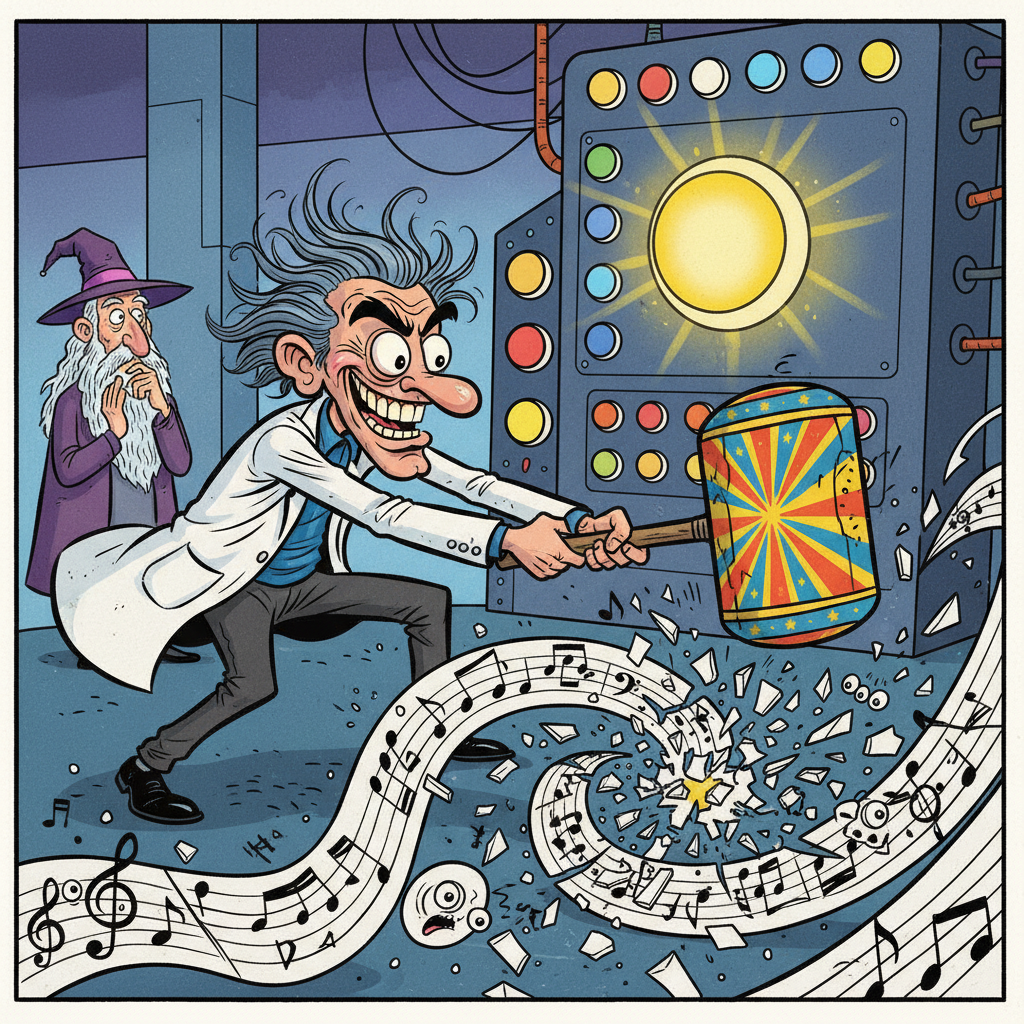
NEW YORK, NY — A comprehensive new study published by the Institute for Contemporary Cultural Degeneration has definitively concluded that all music, regardless of genre, complexity, or artistic intent, is now universally categorized and understood solely as 'vibes.' The findings suggest a dramatic simplification in how humans process auditory information, particularly in the digital age.
“Our data indicates a complete collapse of traditional musical lexicon,” stated lead researcher Dr. Evelyn Harmon, a semi-retired ethnomusicologist now primarily focused on TikTok trends. “Terms like 'harmony,' 'melody,' 'rhythm,' and even 'genre' have been largely supplanted by a singular, amorphous concept of 'vibe.' It’s either a good vibe, a bad vibe, or a vibe that just *is*.”
The study, which analyzed millions of online music discussions, streaming service tags, and casual conversations, found that even highly complex or politically charged albums are ultimately distilled down to their 'vibe quotient.' For instance, a critically acclaimed electronic album praised for its intricate production and socio-political commentary was most frequently described by listeners as having a 'very particular vibe.'
“We tried to introduce more nuanced descriptors, but the subjects just looked at us blankly,” explained research assistant Kyle Jenkins, 23. “We’d say, ‘This track features an innovative use of polyrhythms and a searing critique of late-stage capitalism,’ and they’d just nod and say, ‘Yeah, it’s a whole vibe.’”
Industry insiders are reportedly thrilled with the findings. “It simplifies everything,” said a major label executive who asked to remain anonymous. “No more expensive focus groups on lyrical content or instrumental virtuosity. Just tell us if it vibes.”
Experts predict that within five years, music schools will replace all theory classes with a single course: 'Advanced Vibe Identification.'