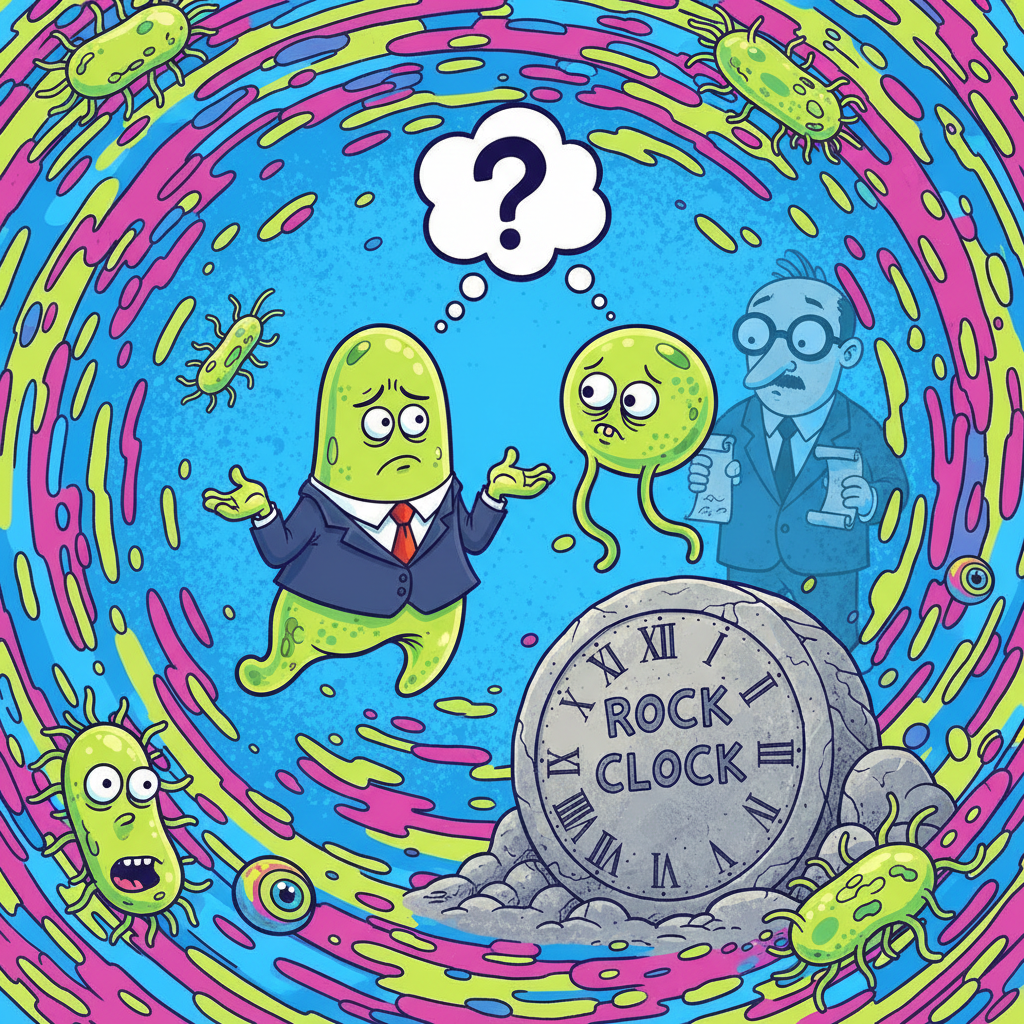
LAUSANNE, SWITZERLAND – A revolutionary new geological 'rock clock' developed by researchers at the University of Lausanne has confirmed that Earth’s earliest complex animal life, dating back over 500 million years, exhibited a remarkable lack of foresight, often making crucial evolutionary decisions on the fly.
Published in *Nature Communications*, the 'rock clock' was expected to reveal intricate patterns of ancient climate events and biological adaptation. Instead, lead researcher Dr. Elara Vance noted, “What we found was less about grand design and more about a series of increasingly panicked improvisations. It appears the Cambrian Explosion was less an explosion of life, and more a collective 'Oh, crap, we need gills *now*' moment.”
The highly precise dating tool, capable of measuring time with 'unprecedented precision,' indicated that many significant evolutionary leaps occurred in what appeared to be reactive bursts, rather than long-term strategic development. “We’re seeing evidence of species essentially saying, 'Well, this is happening now, so I guess we’ll just… grow an exoskeleton?'” explained Dr. Vance. “It’s eerily similar to how most project deadlines are met today.”
Geochronologist Dr. Marcus Thorne, who was not involved in the study but reviewed the findings, commented, “This research fundamentally shifts our understanding of primordial existence. It suggests that the entire history of life on Earth, from the first multicellular organisms to the invention of the internet, has been characterized by a pervasive sense of 'we'll figure it out as we go along.' It’s both humbling and, frankly, a little concerning.”
The findings are expected to provide comfort to anyone currently navigating their own existence without a clear, long-term plan.