
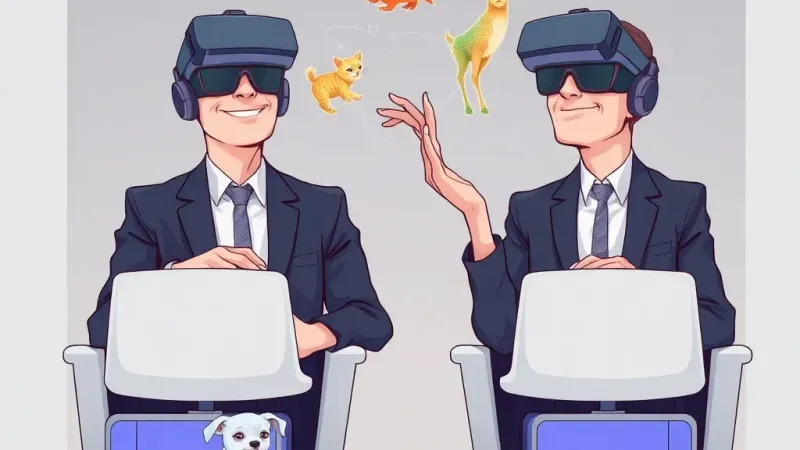
A groundbreaking new holiday initiative is set to redefine animal welfare education by teaching children "compassion" for animals exclusively through immersive virtual reality experiences. The program, dubbed "Empathy-VR for the Modern Pet," promises to instill profound empathy without the mess, unpredictable behavior, or potential liability associated with actual living creatures.
Developed by the newly formed "Conscious Connectivity Coalition" (C3) in partnership with major tech firms and a prominent fast-food chain, the program features highly detailed, photorealistic digital animals. Participants don state-of-the-art haptic-feedback headsets to interact with algorithmic renderings of endangered pandas, adoptable puppies, and even a fully-renderable, ethically ambiguous factory farm pig. Each interaction, from virtual petting to simulated rescue missions, is meticulously guided by AI-powered emotional response analytics, ensuring optimal "compassion quotient" outcomes and compliance with patented empathy metrics.
"We've optimized the empathy pathway for maximum data capture and minimal real-world inconvenience," explained Dr. Felicity Spark, C3's Chief Empathy Architect and former head of brand synergy at a major cryptocurrency firm. "Children can now experience the full emotional spectrum of animal suffering and joy from a safe, climate-controlled distance. No fur, no claws, no unexpected bathroom breaks—just pure, unadulterated, trackable feeling, perfectly calibrated for the modern attention economy."
Critics, primarily a group of bewildered zookeepers, actual animal rescue volunteers, and several exhausted parents, questioned the efficacy of simulated compassion. "You can't learn to truly care about a squirrel by navigating a menu to virtually give it a digital nut, especially when that nut then auto-generates a microtransaction pop-up," stated Bartholomew 'Barty' Finch, a veteran animal control officer with 35 years of experience, holding a bandaged finger. "Last week, a kid in the program tried to pet a stray cat by tapping its head repeatedly with a touchscreen gesture. We had to explain that real cats don't come with an undo button or a haptic feedback setting for purrs." Finch’s concerns were quickly dismissed by C3 as "legacy empathy resistance" and "unquantifiable anecdotal data."
The program also boasts a "Conscious Consumption Module" where children virtually "rescue" digital chickens from a perpetually glitching, dystopian egg farm, only to then be presented with an in-VR coupon for a real-world 10-piece nugget meal at a partner restaurant. A premium tier offers access to exclusive "sentient algorithm" animal companions, personalized "empathy achievements," and NFT certificates of "virtual ethical stewardship" that grant tiered bragging rights on social media. The future of compassion, it seems, is fully monetized, gamified, and completely offline, streamlining messy altruism into a pristine, marketable data point.
Experts predict the initiative will finally bridge the empathy gap between humans and animals, largely by eliminating the need for animals.