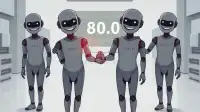
A sweeping new analysis from the 'Future of Work' consortium, co-sponsored by leading tech conglomerates and several university endowments, has officially reclassified recent university graduates as 'legacy hardware,' noting their increasingly limited compatibility with modern corporate infrastructure. The report, titled "Human-Resource Deprecation: Optimizing the Post-Organic Workforce," concludes that the traditional entry-level human worker now presents significant overhead and efficiency challenges when compared to readily deployable AI solutions.
"We're seeing a significant depreciation curve across all four-year degree holders," stated Dr. Serena Vesper, Head of Human-Centric Legacy Optimization at Nexus Innovations, a key contributor to the study. "While previous generations might have valued human creativity and critical thought in junior roles, today's competitive landscape prioritizes scalable, emotion-neutral data processing. Graduates, with their finite processing speeds, propensity for 'lunch breaks,' and a baffling need for 'healthcare benefits,' simply can't compete with a neural net operating at 100 petaflops on a continuous loop." Dr. Vesper added that the current unemployment rate for 22-27 year-old college graduates, now hitting 5.8% at the end of 2025, directly correlates with a 7% year-over-year increase in AI-driven task automation across sectors traditionally reliant on entry-level labor.
The consortium's findings specify that while AI excels at predictable, high-volume tasks, human graduates still retain a niche in what the industry terms "human-adjacent friction management" and "empathy processing units." These specialized roles often involve listening to customer complaints too bizarre or emotionally volatile for even advanced chatbots to process without risking an algorithmic breakdown, or providing physically present "warm bodies" for compliance audits in industries still clinging to outdated regulatory frameworks. "Think of them as highly specialized, battery-powered redundancies," explained Chad Kensington, CEO of Gen-Z Solutions, a firm specializing in AI workforce integration. "They provide a necessary, albeit costly, failsafe for those awkward moments when a client absolutely insists on 'speaking to a real person,' before we inevitably transition that interaction to a deepfake avatar trained on their voice."
The report also detailed a new classification for academic institutions, dividing them into "Tier 1: AI Data Farm & Prompt Engineer Incubators" and "Tier 2: Historical Human-Centric Arts & Sciences Repositories," with the latter facing significant funding cuts. Corporations, responding to the findings, are now offering specialized "retrofit" programs for existing human employees and new hires, encouraging voluntary enrollment in "skill migration" seminars focused on advanced prompt engineering, AI monitoring, and developing optimal ergonomic desk posture for extended, unsupervised screen time.
"Our goal is not to eliminate human talent entirely, but to integrate them into the AI ecosystem as gracefully as possible," Kensington clarified. "We're developing a new certification program for 'Human-AI Synergy Specialists,' which, frankly, is mostly about teaching them how to cheerfully not get in the AI's way while occasionally debugging a printer." The consortium's final recommendation to universities included a mandate to include compulsory modules on "data servitude," "algorithmic compliance," and "how to cheerfully accept your new robotic overlords without excessive emotional leakage."