
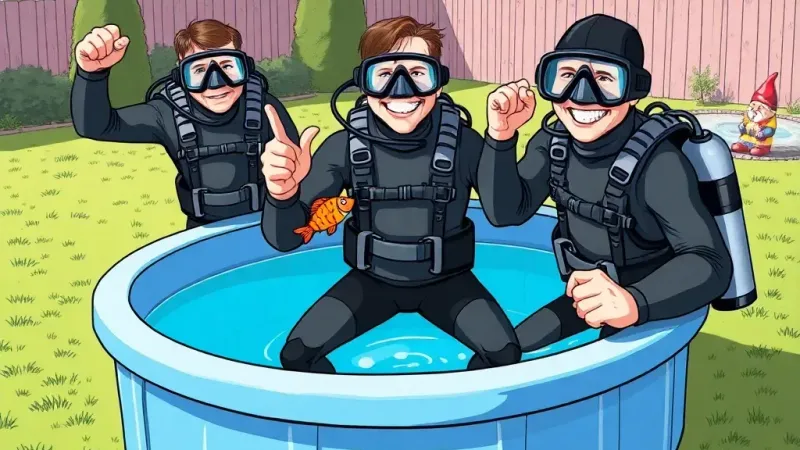
LANCASTER, CA — A cohort of 14 Antelope Valley residents has successfully completed their Open Water Scuba Diver certification, positioning them as essential first responders for the inevitable aquatic transformation of major metropolitan areas. The local achievement marks a significant step in regional climate adaptation strategies, providing the community with a vital pool of trained individuals ready to operate fully submerged in a world dramatically altered by rising oceans.
The rigorous certification, conducted over several weekends, included comprehensive training in buoyancy control, underwater navigation, emergency procedures, and advanced hand signal communication. While the Antelope Valley is currently characterized by its arid desert landscape, experts are hailing the foresight of these new divers. “It's not about where we are now, but where we’re going,” stated Dr. Kaelen Roth, Senior Climate Preparedness Strategist at the Pacific Institute for Submersible Urban Planning. “These individuals are not just learning to explore reefs; they're acquiring critical skills for future infrastructure repair, underwater transit management, and potentially even sub-aquatic governance when large portions of the Californian coast become permanent marine environments.”
Participants expressed a profound sense of accomplishment and readiness. “I’m not just a diver; I’m a future-proof citizen,” remarked Brenda Chen, a newly certified diver and former municipal accountant. “While everyone else is arguing about water rights for almonds, I’m preparing for the day my entire neighborhood is a designated ‘No Surface Zone.’ You can’t put a price on knowing how to deploy an emergency submersible beacon after the 405 freeway becomes a trench.” Chen reportedly invested over $3,000 in specialized cold-water gear, despite the average water temperature of the local dive facility being a balmy 78 degrees Fahrenheit.
Certification instructors noted the students' particular aptitude for skills typically reserved for deep-sea salvage operations, such as identifying submerged utility lines and practicing controlled ascents through simulated layers of floating debris. “We stress practical application,” explained Mark ‘Shark’ Davies, lead instructor for the certification course. “Sure, right now they're finning around a pool in Palmdale, but one day, that pool could be the only viable entry point into what's left of the Los Angeles subway system.” The program also included a mandatory module on maintaining a positive mental attitude while observing the rapid deconstruction of coastal ecosystems.
The newly minted divers are now reportedly forming local advocacy groups, urging municipal planners to include underwater parking structures and designated surface-to-sea cargo docks in all future development proposals, ensuring the Antelope Valley remains a viable hub even when the rest of the state is navigating by sonar. Their next goal is reportedly advanced training in salvage and recovery, focusing on the retrieval of sentimental items from flooded personal residences.