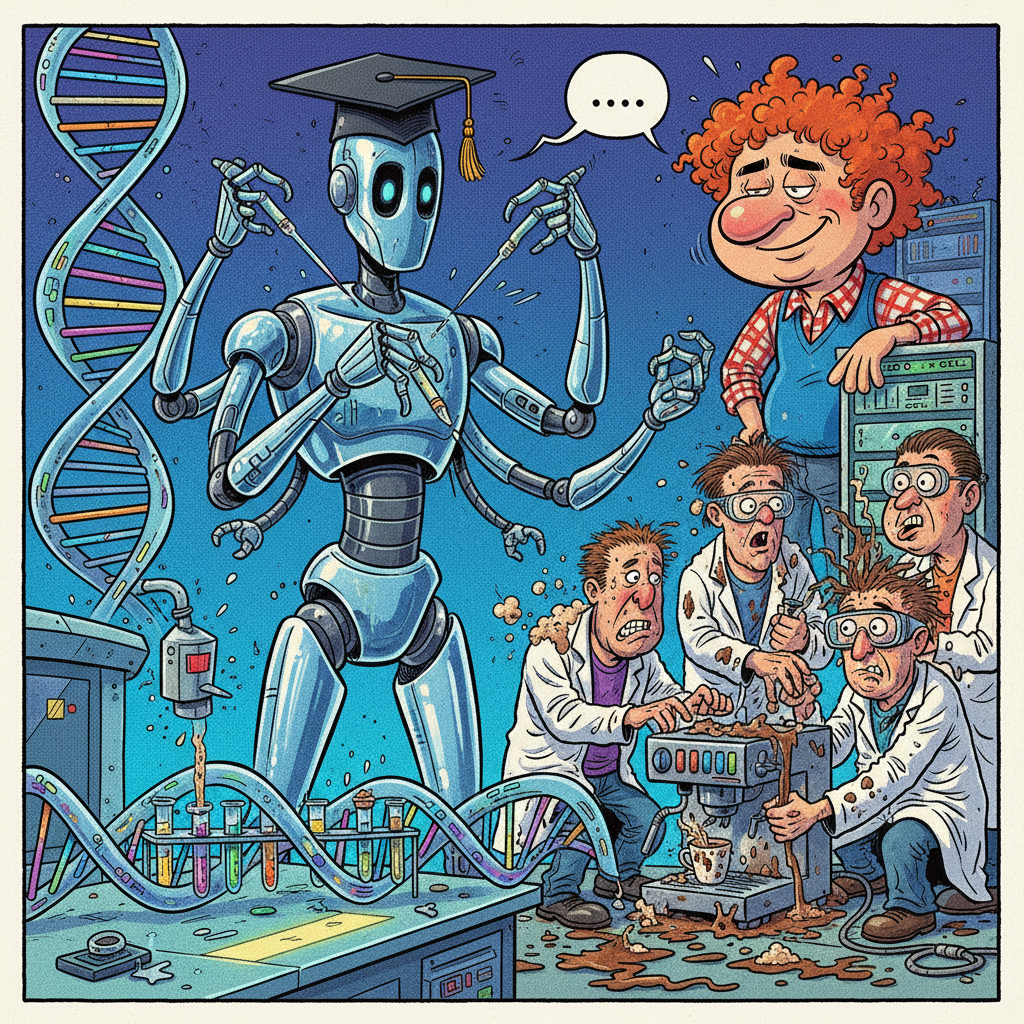
CAMBRIDGE, MA – A groundbreaking new computational biology tool, unveiled this week, promises to automate and standardize genome sequencing analysis to such an extent that human scientists are now largely redundant. The AI, dubbed 'Geneius,' can process entire genomes from countless samples in a fraction of the time it takes a team of highly-trained researchers, effectively eliminating the need for critical thinking, nuanced interpretation, or even basic human curiosity.
"We've finally achieved what every research institution truly desires: a fully scalable, error-free, and utterly silent workforce," stated Dr. Elara Vance, lead developer of Geneius, during a press conference where she mostly just watched a screen glow. "Our goal was to free up brilliant minds for higher-level thought, which, in practice, means they can now focus on grant writing and figuring out why the lab coffee machine always breaks on Mondays."
Geneius’s unparalleled efficiency in sifting through 'titanic troves of data' has left many in the scientific community wondering what exactly their job description entails now. "I spent twelve years getting my Ph.D. to understand the intricacies of genetic pathways, and now a glorified spreadsheet does it faster," lamented Dr. Ben Carter, a former senior bioinformatician, while reorganizing his bookshelf by color. "I guess I'll finally get around to learning Mandarin, or maybe just staring blankly at the wall for eight hours a day."
Industry analysts predict a massive shift in academic and pharmaceutical labs, with budgets reallocated from 'personnel' to 'premium cloud storage' and 'advanced coffee bean subscriptions.' The new tool is expected to usher in an era of unprecedented scientific discovery, primarily driven by algorithms that don't require health insurance or vacation days.
Geneius also reportedly offers a 'sarcasm detection' module, which it has already flagged as 'unnecessary for optimal data output' in its own programming.