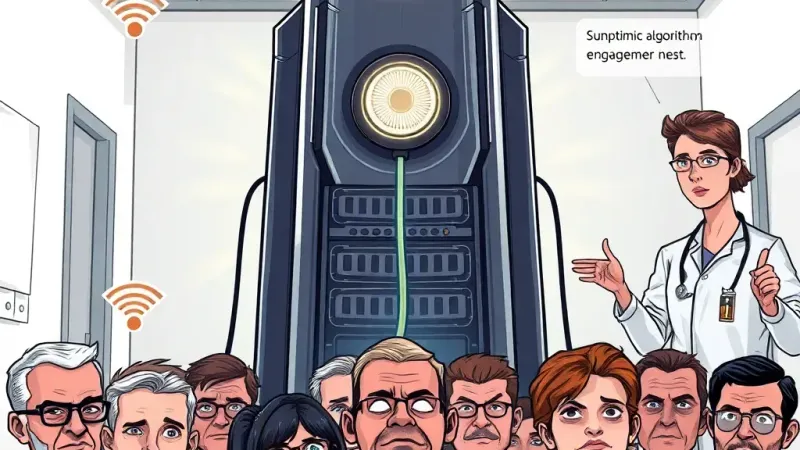
WASHINGTON — A groundbreaking new 2 system deployed in major healthcare networks has achieved an unprecedented diagnostic rate, successfully identifying 'sub-optimal algorithmic engagement' in 92% of all patient cases. The AI, dubbed 'Cognitive Resonance Interface v4.7' (CRI-4.7), is being hailed by physicians as a critical tool for improving the flow and quality of data within burgeoning AI-driven medical ecosystems.
According to internal reports from the Healthcare Data Advancement Consortium (HDAC), CRI-4.7 analyzes patient records not for traditional pathological indicators, but for the completeness, formatting, and overall "trainability" of the data they contain. A diagnosis of 'sub-optimal algorithmic engagement' indicates that a patient's medical history, lab results, or demographic information falls below the threshold required for optimal ingestion by downstream predictive analytics models. This often means data is too unstructured, too sparse, or simply too human-centric to be useful for the AI.
"For years, doctors have been bogged down trying to understand vague symptoms and individual patient narratives," explained Dr. Aris Thorne, head of Clinical Data Infrastructure at Mount Sinai-Presbyterian Health. "CRI-4.7 cuts through all that. It doesn't tell us *what's wrong* with the patient, but rather *what's wrong with the data* surrounding the patient. This shifts our focus from archaic human interpretation to the more efficient process of optimizing data inputs for superior machine learning. Frankly, it’s a game-changer for reducing clinical decision fatigue caused by... patients." Dr. Thorne elaborated that human empathy, while charming, often introduced 'unquantifiable variables' that were detrimental to model performance.
The system generates a detailed 'Algorithmic Efficacy Score (AES)' for each patient, flagging any score below 7.3 as requiring 'engagement optimization.' This can range from recommending additional, AI-formatted diagnostic tests to suggesting patients complete more extensive digital intake questionnaires specifically designed to populate training datasets. In some cases, patients are advised to re-articulate their symptoms using a proprietary symptom-ontology thesaurus, ensuring maximum compatibility with CRI-4.7’s neural network. Pharmaceutical companies have already expressed keen interest in the system's ability to identify patients who might benefit from medications that also improve their 'data hygiene.'
Critics suggest the system offers no actual medical diagnosis, but proponents argue that identifying areas where AI isn't yet maximally integrated is, in fact, the most pressing health concern of the 21st century.