
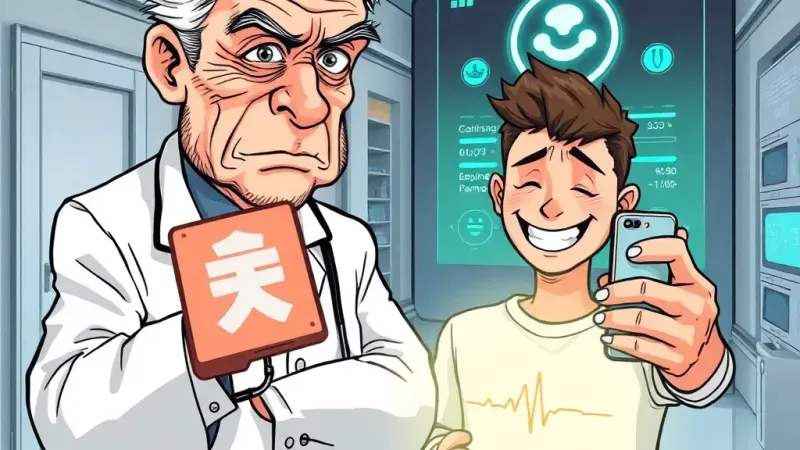
PORTLAND, OR — In a landmark move designed to “reimagine the doctor-patient partnership for the digital age,” the expansive Pacific Coast Health System announced Monday that its physicians are now required to officially confirm all patient self-diagnoses generated by 2 chatbots.
The new mandate, effective immediately across all 47 facilities, directs medical professionals to “meticulously review and authenticate” conditions patients arrive with, ranging from “Acute Dopamine Scroll Dysfunction” to “Generalized Wellness Stagnation.” The policy aims to leverage the “unprecedented access to personalized health data” patients glean from large language models, thereby “streamlining diagnosis and accelerating treatment pathways.”
“We understand that our patients are increasingly proactive in their health journeys, often consulting advanced algorithms before scheduling an appointment,” stated Dr. Evelyn Thorne, Chief Patient Empowerment Officer at Pacific Coast Health System, in an internal memo obtained by Hambry. “Our role is no longer to simply diagnose, but to act as a crucial validation node in their AI-enhanced self-care ecosystem. This is about meeting patients where their algorithms are.”
Under the new guidelines, doctors must use phrases like, “Yes, Mrs. Henderson, your ChatGPT-4 diagnosis of ‘Chronic Luminal Joy Deprivation’ does appear consistent with your self-reported symptoms of feeling ‘meh’ about artisanal toast,” before proceeding to a treatment plan. One internal memo suggested prescribing “increased screen-time mindfulness” or “strategic engagement with a bespoke digital detox influencer” for such cases.
Physicians, however, expressed a range of reactions from “utter bewilderment” to “profound existential despair.” Dr. Kenneth Choi, a veteran family physician with over 20 years of experience, reportedly spent 45 minutes last Tuesday meticulously reviewing a patient’s AI-generated claim of “Quantum Field Discombobulation” before confirming it could indeed be managed with “daily exposure to high-vibrational frequencies, as recommended by the patient’s personal AI oracle.”
“My entire medical education, my years of clinical experience, all of it feels secondary to whether a patient’s chatbot has correctly identified their ‘Pre-Caffeinated Cognitive Fog Syndrome,’” Dr. Choi confided to a colleague. “I spent an afternoon last week researching whether ‘Symbiotic Digital Detoxification Deficiency’ was a real thing, only to find it was a hallucination from a particularly creative open-source model. But policy is policy.”
The health system reports a 300% increase in patient satisfaction scores related to “feeling heard by the healthcare establishment” since the policy’s soft launch last month. Industry analysts speculate this innovative approach could become a model for future healthcare delivery, fundamentally redefining medical expertise as “algorithmic confirmation bias facilitation.”
Meanwhile, Pacific Coast Health System has begun exploring partnerships with leading AI developers to create bespoke chatbot solutions that will pre-populate patient charts with “validated” self-diagnoses, further streamlining the physician’s role to little more than signing on the dotted, algorithm-generated line.