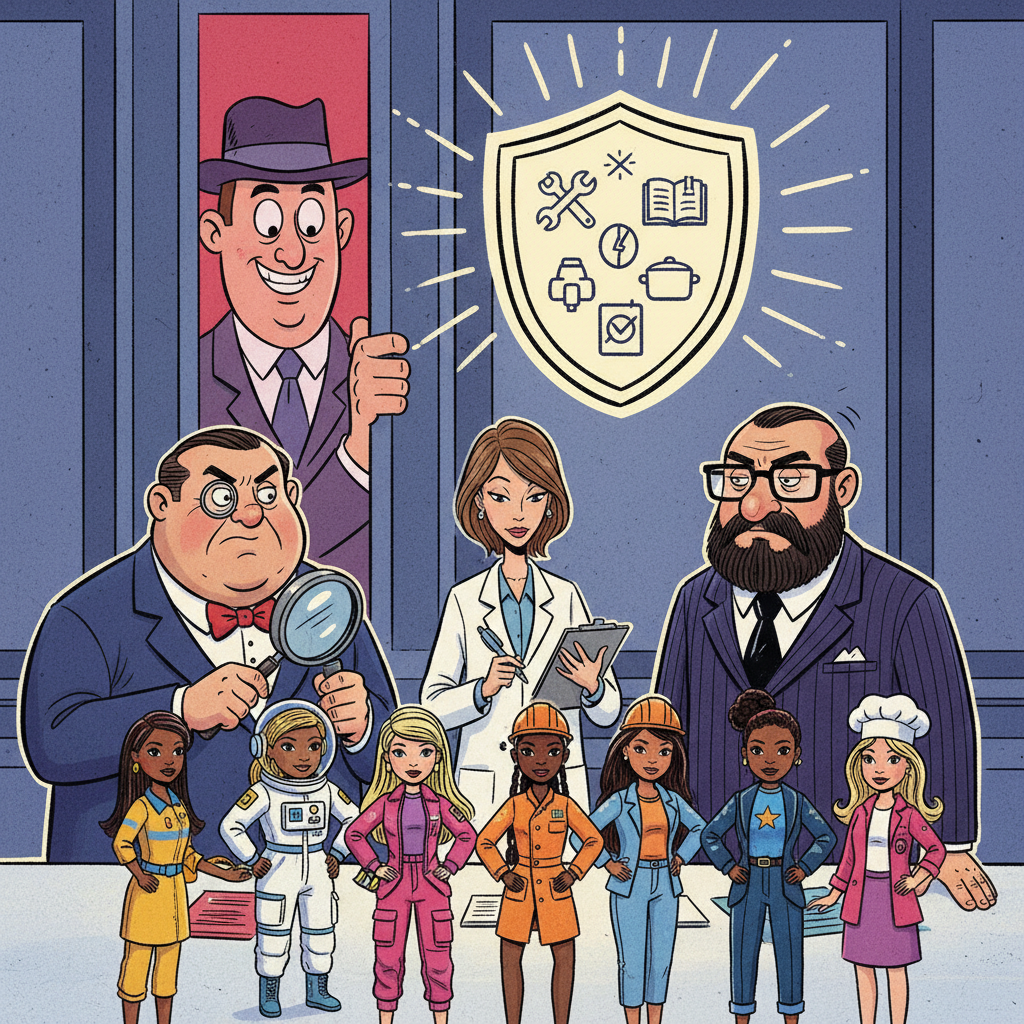
BERLIN — Following reports of a German woman successfully identifying 19 distinct Barbie dolls while blindfolded in under three minutes, leading educational and corporate institutions are scrambling to integrate 'Advanced Doll Recognition' into their core curricula and hiring protocols.
Dr. Elara Vance, head of the Global Competency Institute, stated that the achievement by Bettina Dorfmann, already known for her extensive Barbie collection, signals a paradigm shift. “For too long, we’ve prioritized outdated skills like 'critical thinking' or 'basic arithmetic,'” Vance explained. “But in an increasingly complex, plastic-molded world, the ability to discern a 1985 Day-to-Night Barbie from a 1992 Totally Hair Barbie by touch alone is, frankly, indispensable.”
Major corporations are reportedly revising job descriptions, with many now listing 'demonstrable blindfolded Barbie identification proficiency' as a preferred, if not mandatory, qualification. A spokesperson for a prominent tech firm, who wished to remain anonymous, commented, “We’re looking for candidates who can innovate under pressure, adapt to new sensory inputs, and, crucially, tell the difference between a Superstar Barbie and a Hawaiian Fun Barbie without visual cues. It’s about attention to detail, really.”
Critics, however, question the immediate practical applications, with one anonymous source quipping, “I just hope my surgeon can identify my appendix without needing to feel up a few dozen plastic torsos first.”