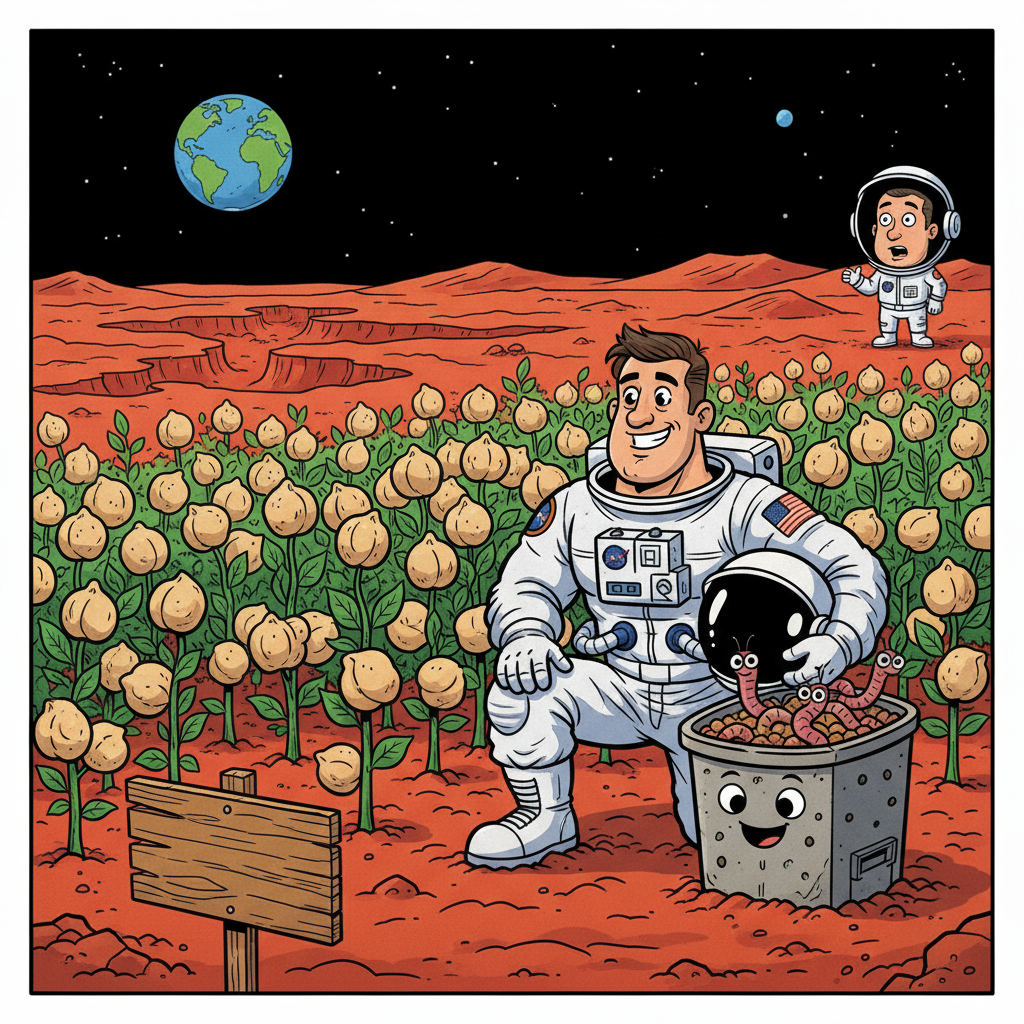
PASADENA, CA – Following promising experiments with simulated extraterrestrial soils, NASA has officially pivoted its Mars colonization strategy to focus almost exclusively on chickpea cultivation, sources confirmed Friday. The agency, which previously envisioned a future of advanced hydroponics and bespoke nutrient solutions, now believes the key to off-world survival is a robust supply of hummus ingredients.
“We’ve been overthinking this for decades,” stated Dr. Aris Thorne, head of NASA’s new Interplanetary Legume Initiative. “It turns out, if you just add some fungi and a truly staggering amount of worm compost to fake Martian dirt, chickpeas thrive. It’s almost insultingly simple.” Dr. Thorne added that early microbial studies also indicated that certain organisms could survive on Mars by essentially 'sweating' water from the atmosphere, a process he described as “deeply unglamorous but highly effective.”
The revelation has sent shockwaves through the aerospace industry, with several major defense contractors now scrambling to retool their lunar lander designs to accommodate industrial-scale vermicomposting facilities. Critics, however, questioned the long-term viability of a diet consisting solely of chickpeas, even if they are grown on another planet.
“While we applaud the scientific breakthrough, we must ask: what about variety?” queried Senator Elaine Vance (R-TX) during a recent congressional hearing. “Are we really sending our best and brightest to live on a planet where every meal is just a different consistency of garbanzo bean?” NASA declined to comment on the culinary implications, stating their immediate priority was securing a reliable supply of worms capable of surviving space travel.
The agency is reportedly already drafting mission proposals for 'Operation: Hummus on Mars,' with the first crewed mission now slated to include a dedicated 'Chief Composting Officer' and several thousand pounds of earthworms.