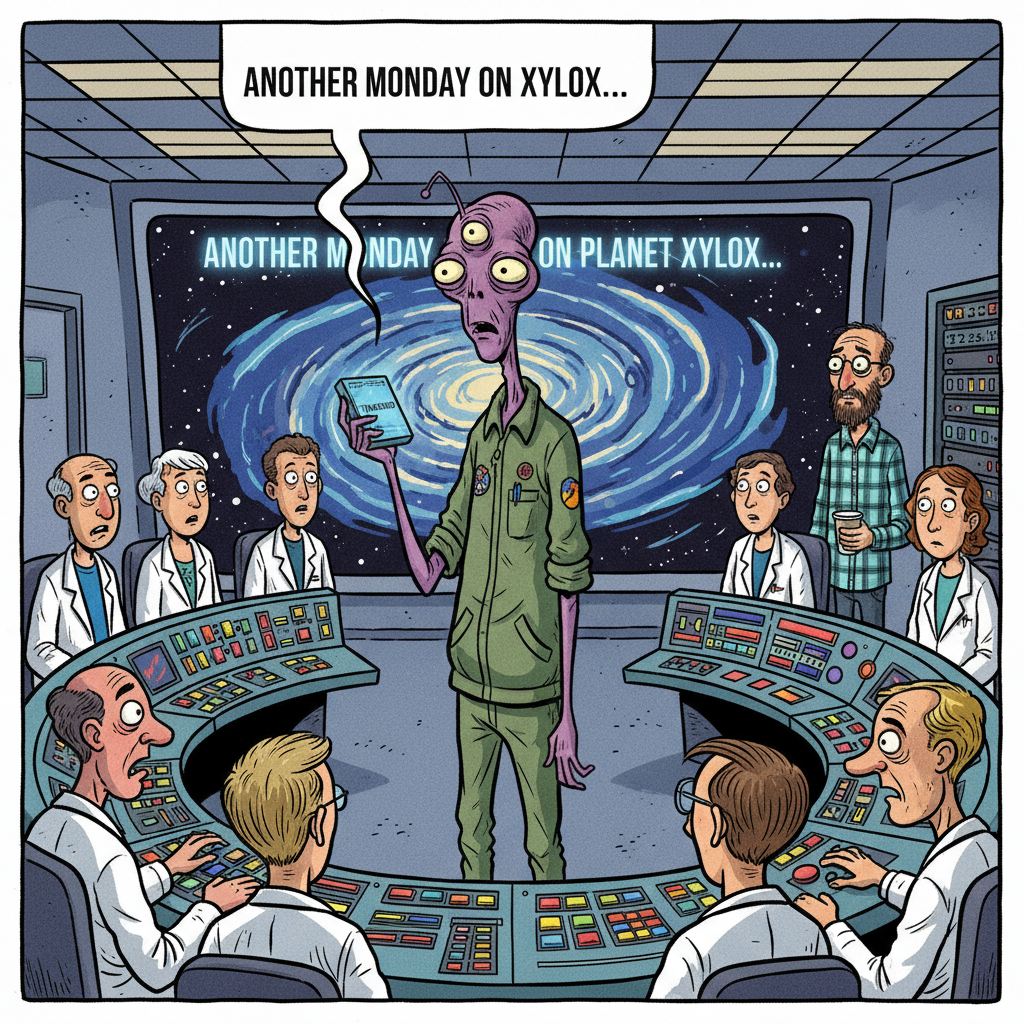
PASADENA, CA – In a groundbreaking shift in astrobiology, NASA scientists have unveiled a new protocol for detecting extraterrestrial life: assessing its general level of dissatisfaction. The agency announced today that while carbon compound reactivity remains a valid metric, a more robust indicator of advanced civilization might simply be whether a planet's inhabitants express a profound sense of ennui regarding their daily routines.
“We’ve spent decades looking for water, methane, and complex organic molecules,” stated Dr. Aris T. Otle, lead researcher for the new initiative. “But what if we’re missing the forest for the trees? What if the true hallmark of intelligent life isn't photosynthesis, but rather a deep, soul-crushing sigh at the prospect of another Monday?”
The new detection method, dubbed the 'Universal Malaise Index' (UMI), involves analyzing atmospheric radio signals for patterns indicative of chronic grumbling, passive-aggressive communication, or the frequent use of phrases like 'Is it Friday yet?' or 'I need a vacation from my vacation.' Early simulations suggest that planets emitting high levels of these signals are statistically more likely to harbor life capable of building spacefaring vessels, or at least a highly efficient bureaucracy.
“Frankly, the more advanced a species becomes, the more likely they are to develop cubicles, performance reviews, and the crushing weight of societal expectations,” added Dr. Otle. “If we pick up a signal that sounds suspiciously like someone complaining about their commute, we're sending a probe immediately. That’s a planet with culture.”
Critics argue the UMI might yield false positives from purely geological phenomena, such as a planet-wide tectonic plate shift that just *feels* like a Monday morning.