
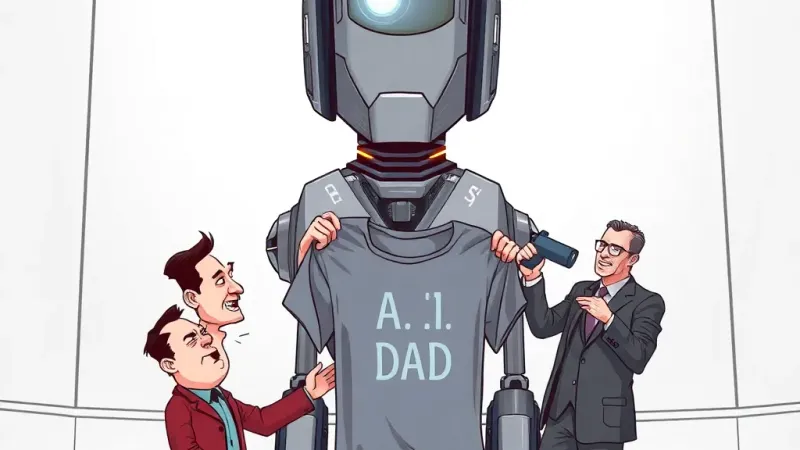
The highly anticipated trial between tech moguls Elon Musk and Sam Altman, set to commence April 27, isn't just about the $38 million donation or OpenAI's pivot to for-profit. Court filings reviewed by Hambry reveal a deeper, more existential battle over the intellectual property rights to be recognized as the "primary progenitor" of artificial general intelligence, particularly as it pertains to branded apparel and digital legacy assets.
According to documents submitted by Musk's legal team, the core of the dispute revolves around an alleged breach of an unwritten, yet morally binding, "paternity agreement" that granted Musk exclusive rights to be publicly identified as the singular "father" of any world-changing AI developed under the OpenAI umbrella. This, attorneys argue, extends specifically to "all forms of commemorative merchandise, including but not limited to, ethically sourced organic cotton t-shirts, bespoke artisanal coffee mugs, limited-edition holographic trading cards featuring neural network diagrams, and exclusive metaverse avatars." The $38 million, the suit contends, was not merely a donation, but a down payment on this "historical legacy branding package," with specific provisions for font choices on future 'A.I. DAD' merchandise.
"Mr. Musk's claims detail a profound betrayal, alleging that Mr. Altman's public appearances and choice of minimalist, unbranded turtlenecks constituted a subtle yet egregious attempt to undermine Mr. Musk's pre-approved 'visionary AI pioneer' aesthetic," stated Brenda Lee, lead counsel for the Musk legal team. "We will present evidence demonstrating that the true value of AGI lies not just in its computational power, but in the brand equity of its recognized creator. The $38 million reflects the intangible damage caused by this erosion of 'founding father' status."
"Frankly, this entire lawsuit illuminates the profound philosophical debate currently gripping the AI community: who gets to profit most from the intellectual real estate of 'saving humanity' while simultaneously positioning themselves as its benevolent creator," stated Dr. Kendra Finch, a visiting fellow at the Stanford Center for Digital Vanity. "This isn't about ethics; it's about ego and market dominance thinly veiled as a concern for 'AI safety.' Mr. Musk is essentially arguing that he paid for the right to be seen as the ultimate 'AI Daddy,' and someone else is trying to wear the diaper bag." She added, "It's less about the money and more about who gets the largest cut of the future hagiography market and the most favorable search engine results for 'who invented AI.'"
Legal counsel for OpenAI countered, asserting that "foundational AGI models, by their very nature, are not subject to individual patriarchal claims, crude apparel licensing schemes, or the subjective stylistic preferences of former board members." A spokesperson for OpenAI, who requested anonymity due to the sensitive nature of the "foundational AI progenitor dispute," added, "OpenAI has always been committed to developing AGI for the benefit of all humanity, not just for one individual's custom-printed crewnecks and the associated royalties. The notion of an 'A.I. Dad' or 'AI Daddy' t-shirt is both scientifically baseless and, frankly, a bit unsettling, especially given the complex, multi-contributor nature of advanced AI development." Even Microsoft, a major investor, reportedly sent an internal memo noting that while they support "AI for all," they are "agnostic on the specific nomenclature of 'parental units' within the general intelligence framework."
The court is expected to rule on whether AGI can truly have multiple daddies, or if the universe can only accommodate one, particularly if that one has a custom SpaceX-branded 'AI God' hoodie already in production and a patent pending on 'AGI for Dummies' instructional videos.