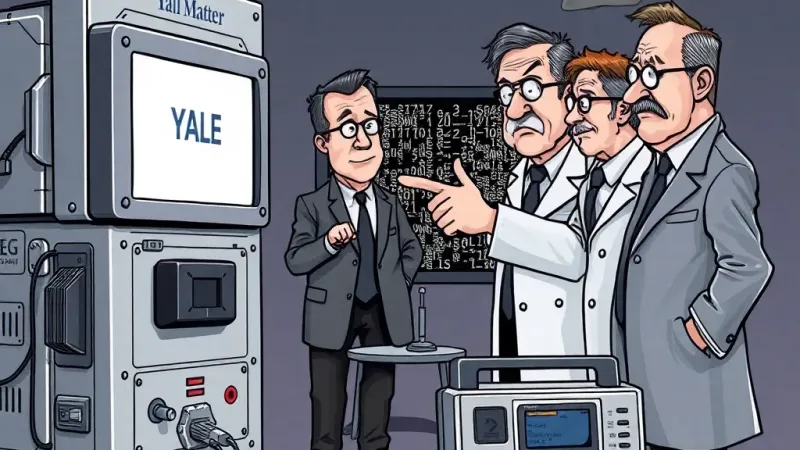
A signal that has baffled physicists and fueled two decades of dark matter speculation has been definitively identified as “just some noise,” according to a groundbreaking new study. The DAMA/LIBRA experiment, a multinational effort operating since 1997 deep beneath Italy’s Gran Sasso mountain, had reported a tantalizing annual modulation that many interpreted as the elusive dark matter interacting with Earth. Now, research led by Yale University has methodically ruled out this explanation, allowing scientists to confidently return to square one.
The initial findings from DAMA/LIBRA had captivated the astrophysics community, offering what many hoped was the first direct detection of the universe’s invisible scaffolding. Millions of dollars and thousands of researcher hours were dedicated to replicating, refuting, or simply agonizing over the perplexing signal. Textbooks, documentaries, and numerous academic careers flourished around the intriguing possibility that the DAMA/LIBRA collaboration had, indeed, found something monumental. It turns out, they had not.
Dr. Aris Thorne, head of the Provisional Interstellar Nothingness Program (PINP) at the Institute for Theoretical Irrelevance, expressed a muted sense of triumph. “For twenty-seven years, we’ve been trying to figure out what that little wiggle meant,” Thorne stated, adjusting his glasses. “Was it a new particle? A cosmic interaction? A subtle flaw in our incredibly expensive detection array? Turns out, it was just… ambient background fluctuations. The universe was basically shrugging at us the whole time. It’s a beautifully elegant non-result, confirming our long-held suspicion that most of what we’re looking for isn’t there.”
The refutation, published in *Physics Review Letters*, employed sophisticated statistical analysis and advanced noise-filtering algorithms, effectively rendering a quarter-century of data collection and subsequent theoretical gymnastics moot. While some physicists lamented the anti-climax, others embraced the clarity. “It’s always good to know what *isn’t* dark matter,” said Dr. Evelyn Reed, spokesperson for the Consolidated Cosmic Voids Exploration Fund, a body that has disbursed billions over the past two decades. “This simply narrows down the infinite number of other things it *could* be. Our commitment to funding the search for things we can’t see, measure, or prove has never been stronger.”
Future dark matter searches are expected to continue with renewed vigor, now unburdened by the nagging concern that someone else might have already found it, only to be mistaken.