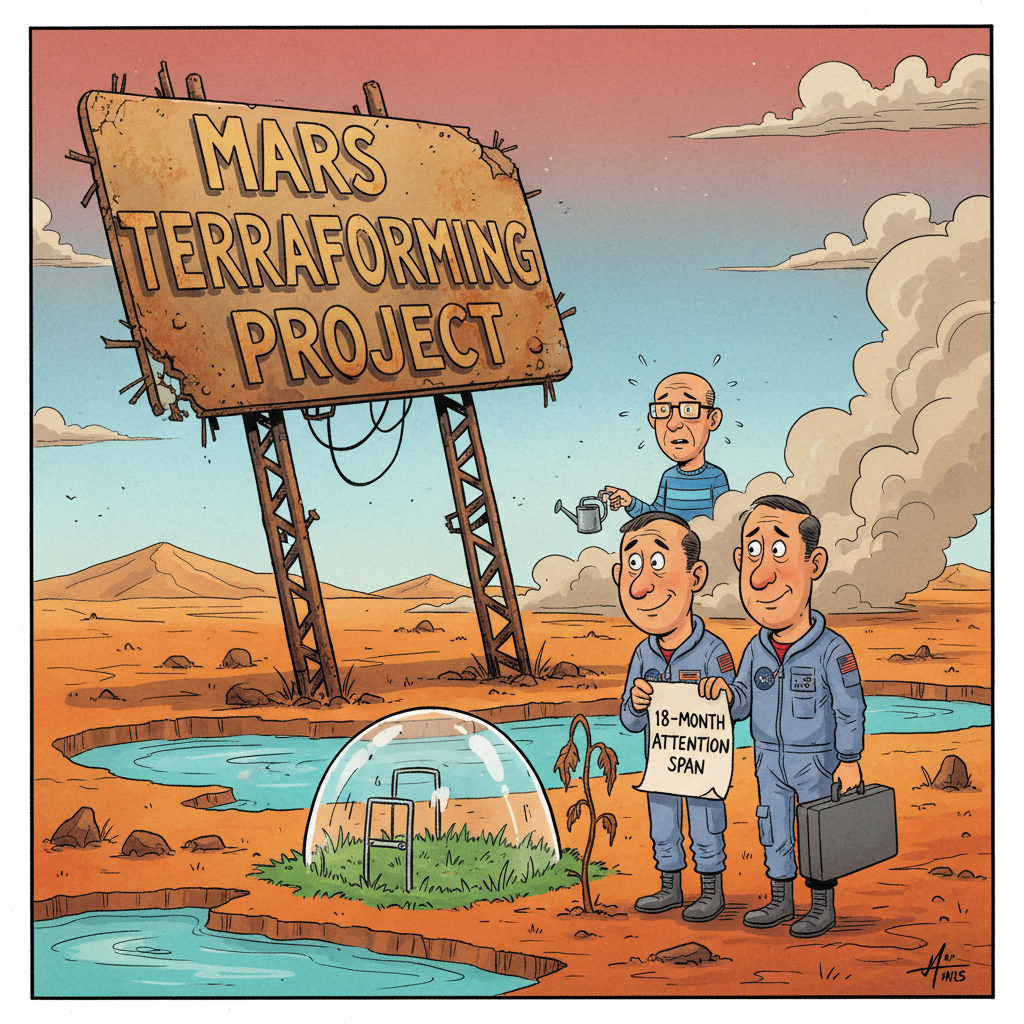
PASADENA, CA – Plans to transform Mars into a habitable planet have been indefinitely shelved after a recent internal review revealed the project would require sustained effort beyond the typical human capacity for follow-through. Scientists at NASA’s Jet Propulsion Laboratory concluded that terraforming Mars, a process estimated to take hundreds to thousands of years, presented an insurmountable challenge to an organism notoriously bad at remembering where it put its keys, let alone managing planetary-scale atmospheric engineering for millennia.
“We initially thought the biggest hurdles would be the lack of a magnetic field or the sheer scale of atmospheric modification,” stated Dr. Evelyn Reed, lead project manager, during a press conference held via Zoom, which she repeatedly struggled to unmute herself from. “But then we factored in humanity’s track record with New Year’s resolutions, diet plans, and any infrastructure project lasting longer than a decade, and frankly, the numbers just didn’t add up.”
According to the new assessment, the logistical nightmare of maintaining industrial-scale greenhouse gas production, asteroid redirection, and atmospheric pressure regulation for generations pales in comparison to the existential dread of asking humans to care about anything consistently. “We can’t even agree on what to watch on Netflix for more than an hour,” added Dr. Reed, shaking her head. “Expecting us to collectively manage a planetary ecosystem for 500 years? That’s just science fiction.”
The project’s indefinite postponement means humanity will likely continue to focus its environmental efforts on debating the efficacy of reusable grocery bags while the Earth slowly cooks.