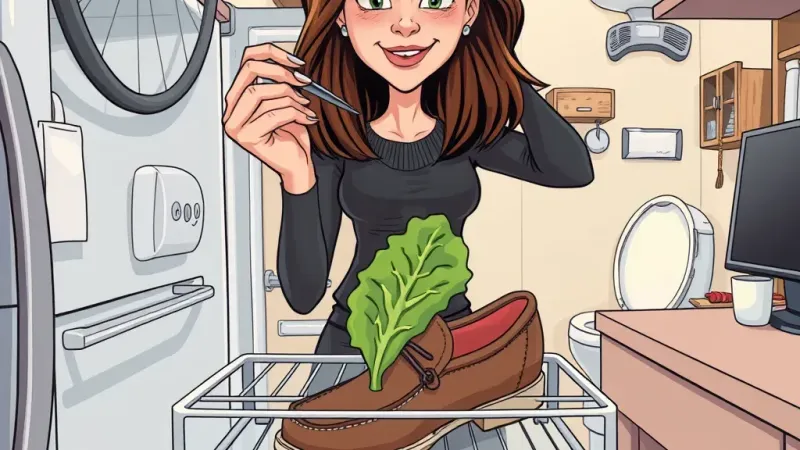
Faced with the crushing reality of a modern economy where a square foot of living space costs roughly the same as a functioning kidney, local lifestyle visionary Chloe Vance has reportedly unlocked the next frontier of domestic efficiency by installing a five-dollar wire shoe rack directly inside her refrigerator.
The organizational breakthrough, which allows Vance to stack three tiers of tupperware-bound chicken thighs precariously above a pair of worn-out Adidas running shoes, was breathlessly documented this week as a masterclass in intentional small-space living. Rather than succumbing to the radical, unhinged notion that humans might deserve refrigerators large enough to hold a head of lettuce without crushing a pint of berries, Vance chose to lean directly into the aesthetic of industrial warehousing.
According to sources close to the dairy shelf, the modular plastic shelving unit was purchased at a suburban big-box retailer during a moment of existential dread induced by the approaching holiday season. By repurposing an apparatus designed exclusively to hold mud-caked footwear by the front door, Vance has successfully doubled her refrigeration capacity, effectively turning the back wall of her Frigidaire into a high-density logistics hub for leftover pad thai and vaguely threatening bags of pre-washed spinach.
"People look at a refrigerator and they see a cold box for perishable items," said Vance, adjusting a stack of leftover artisanal sourdough that is currently resting at a forty-five-degree angle directly above a left orthotic insert. "I look at a refrigerator and I see an under-utilized vertical real estate opportunity. If Amazon can optimize a fulfillment center by cramming maximum inventory into minimum space while ignoring basic human safety standards, I don't see why I can't do the exact same thing with my leftover risotto."
The internet, naturally, has responded with the collective, breathless ecstasy usually reserved for the discovery of a new antibiotic. Digital mood boards are currently flooded with glowing testimonials from other renters paying twenty-two hundred dollars a month for studio apartments that smell faintly of radiator steam, all eagerly rushing out to contaminate their condiments with the microscopic detritus of the urban sidewalk.
Interior design media, ever the faithful handmaidens of late-stage systemic collapse, immediately seized upon the hack as proof that poverty is merely an aesthetic choice if you have enough hot glue and optimism. Leading shelter publications published glowing profiles praising the ingenuity of turning the butter compartment into a makeshift cubby for loafers, framing the complete absence of square footage as a charming, whimsical puzzle rather than a glaring indictment of modern housing policy.
"We are seeing a major cultural shift away from the bourgeois luxury of having a kitchen appliance with enough room to store a turkey, and toward the scrappy, hyper-optimized survivalism of the urban peasant," explained lifestyle trend forecaster Harper Sterling, speaking from a loft where every single surface has been converted into a vertical pegboard. "When you can no longer afford a home with a pantry, you simply reframe your kitchen appliances as boot storage. It's about mindset. It's about leaning into the claustrophobia until it starts to feel like a lifestyle brand."
Critics of the trend, however, have raised minor concerns regarding cross-contamination, pointing out that storing leftover potato salad inches above a sneaker that has recently traversed the floor of a public subway station might introduce a novel bacterial strain capable of destabilizing the local ecosystem. Food safety experts have tentatively suggested that perhaps—just perhaps—people would not need to store their lunches on top of athletic gear if the median wage had increased even once since the George HW Bush administration.
These warnings, predictably, have been ignored. Vance remains unfazed by the skeptics, currently at work on a follow-up project that involves hanging her winter coats from the interior light fixture of her microwave to free up closet space for a second shoe rack.
"You just have to get creative," Vance noted, neatly wedging a carton of expired oat milk between a suede Chelsea boot and a jar of organic dijon mustard. "In this economy, if your groceries aren't giving you a mild fungal infection every time you reach for the mayo, you aren't really living."