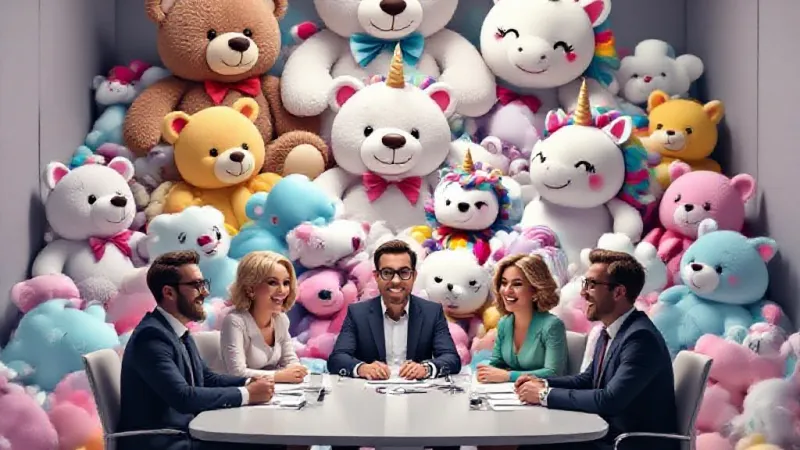
LEWISBURG, PA — The Lewisburg Advocacy Center announced today a groundbreaking breakthrough in addressing systemic societal trauma, attributing its recent success entirely to a generous influx of donated stuffed animals. Sources close to the center indicate that the hundreds of plush toys received have fundamentally shifted the paradigm of community healing, rendering traditional, more resource-intensive methods like therapy, housing assistance, and comprehensive economic support largely obsolete.
"For years, we've been bogged down by complex, multi-faceted problems requiring substantial funding, expert intervention, and long-term commitment," stated Dr. Penelope Hugglesworth, a newly appointed "Chief Comfort Officer" at the center, speaking from a throne of discarded teddy bears. "But then, it hit us: soft, inanimate objects with embroidered smiles. The data is clear: a child cuddling a polyester bear feels temporarily less alone. And by 'temporarily less alone,' we mean 'all problems solved, indefinitely,' or at least until the next news cycle requires a fresh batch of donations." Dr. Hugglesworth emphasized that the sheer volume of plushies means no emotional void will go un-stuffed, at least superficially.
The center’s innovative pivot to "Plushie-Based Intervention" has drawn immediate accolades from politicians eager to tout performative action and reallocate burdensome social welfare budgets. "This is fiscal responsibility at its finest," remarked State Senator Bartholomew 'Barty' Butterfield, pausing his photo-op with a six-foot-tall plush giraffe. "Why continue to invest in expensive programs for mental health, addiction recovery, or poverty alleviation when a fluffy unicorn can deliver comparable emotional regulation at a fraction of the cost? It’s a win-win: taxpayers save, our most vulnerable receive a tangible symbol of… well, *something*, and we get great PR."
Critics, largely dismissed as "anti-comfort cynics" or "those who demand tangible results," raised concerns about the long-term effectiveness of textile-based trauma resolution. However, center officials quickly quashed such negativity, pointing to the undeniable truth that "it's the thought that counts," and thoughts, when translated into mass-produced synthetic fiber, are profoundly impactful. One unnamed board member, speaking on condition of anonymity to avoid being buried in a mountain of sentient-looking stuffed animals, added, "It’s about optics. If it looks like we're doing something, that’s often more effective than actually doing something."
Plans are already underway to expand the program, with proposals to distribute artisanal fidget spinners to address chronic unemployment and brightly colored rubber ducks to combat systemic injustice. The center's success story is expected to revolutionize advocacy efforts nationwide, demonstrating that when faced with overwhelming human suffering, the optimal strategy isn't to confront it directly, but rather to gently smother it with an unending supply of ethically ambiguous, mass-produced cuteness. Future donations are encouraged to focus on items that are soft, non-confrontational, require zero follow-up, and photograph extremely well for social media.