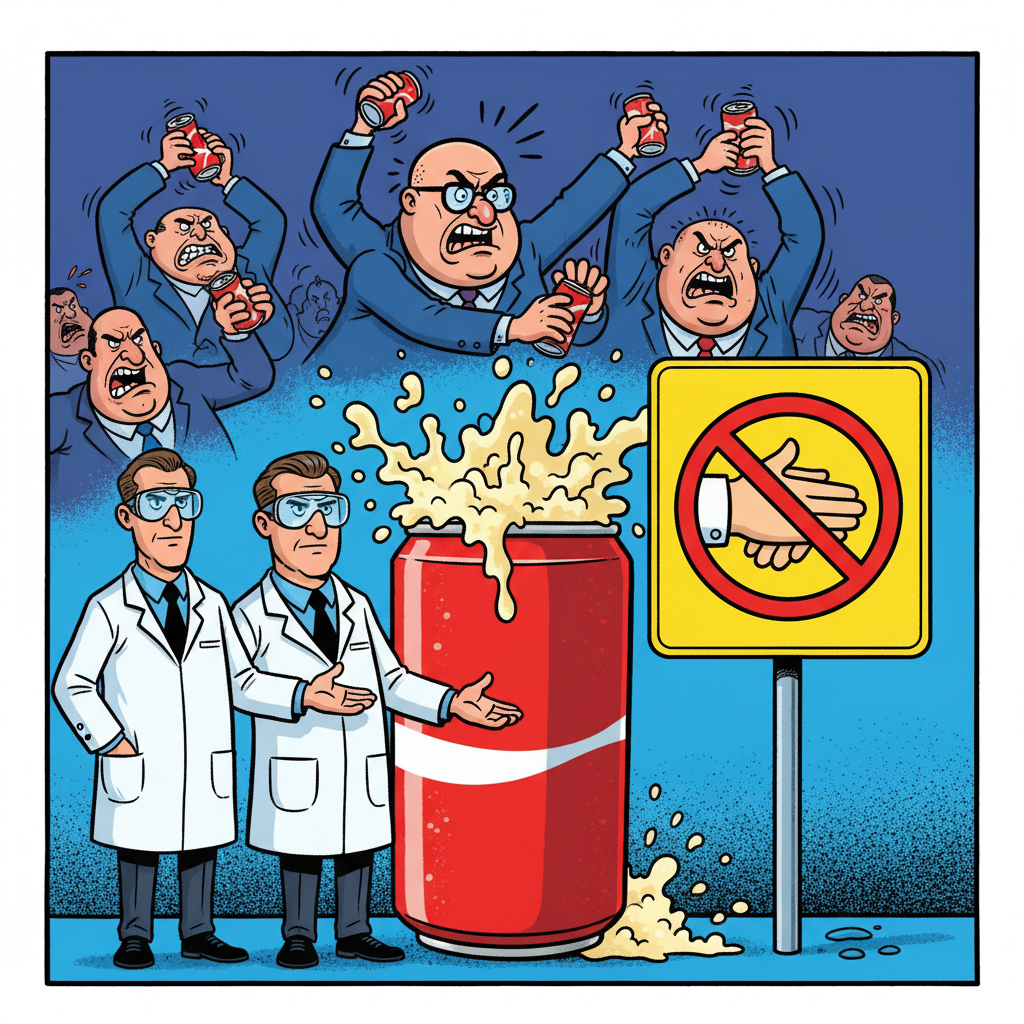
WASHINGTON D.C. — After years of rigorous, taxpayer-funded research, a consortium of the nation's top physicists and fluid dynamics experts has concluded that the popular practice of 'tapping' a carbonated beverage can before opening offers virtually no measurable benefit in preventing an explosive eruption. Their peer-reviewed findings, published today in the Journal of Obvious Observations, instead point to a far simpler, yet often overlooked, solution: refraining from violently agitating the container in the first place.
“Our models, which involved millions of simulated carbon dioxide molecules and countless hours of high-speed video analysis, definitively show that the primary determinant of a soda explosion is the kinetic energy imparted to the liquid,” stated Dr. Eleanor Vance, lead researcher and recipient of the 2023 'Most Patient Scientist' award. “Tapping, while perhaps psychologically comforting, is akin to trying to empty a swimming pool with a teaspoon after someone has just cannonballed into it.”
The study, which cost an estimated $17 million and involved custom-built 'shake-and-tap' robots, has drawn criticism from the American Beverage Association, whose spokesperson, Chad Fizzwell, insisted that “tapping is a time-honored tradition that fosters a sense of anticipation and community. To dismiss it is to dismiss the very fabric of our refreshment culture.” Fizzwell declined to comment on whether the ABA had funded any counter-research advocating for more vigorous tapping.
Experts now suggest that if one absolutely *must* shake a soda, the most effective method for avoiding a sticky disaster is to simply wait an appropriate amount of time for the carbonation to resettle, or, failing that, to open it outdoors and wear protective eyewear. The institute is now seeking funding for a follow-up study on whether 'blowing on hot food' actually makes it cooler.