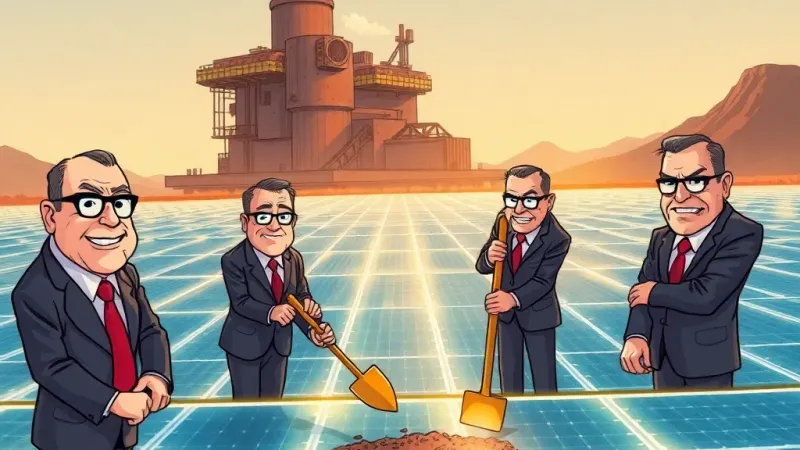
Kairos Energy announced Tuesday it has officially broken ground on its highly anticipated Hermes 2 nuclear reactor, a multi-trillion-dollar project slated to begin producing clean, reliable electricity by the year 2077. Company executives hailed the ceremonial excavation, which utilized a fully automated, laser-guided digging apparatus alongside a commemorative gold-plated shovel, as a monumental leap forward for global energy independence, ensuring future generations will inherit a power grid robust enough to handle the demands of advanced AI-powered smart homes, ubiquitous data centers, and the estimated 17 billion self-driving hover-taxis projected to be operational by that distant era.
"We understand that waiting 53 years for a single kilowatt-hour might seem like an eternity to some of today's more impatient energy consumers," stated Dr. Aris Thorne, Kairos's Chief Futurist and Head of Intergenerational Resource Planning, addressing concerns about the project's ambitious timeline. "But true innovation isn't built in a day. It's built across multiple presidential administrations, several technological paradigm shifts, at least three global pandemics, and approximately two complete generational turnovers. This isn't just a power plant; it's a legacy we’re building for people who haven't even been conceived yet, allowing them to finally solve the energy crises we’re currently grappling with but deem too complex for immediate solutions."
Critics, meanwhile, questioned the practical implications of a power source that will only become fully operational by the time most current decision-makers are either cryogenically preserved or have long since returned to dust. "It’s like building a bridge for a river that hasn't formed yet, just in case a future civilization needs to cross it," commented Dr. Lena Petrova, an independent energy policy analyst at the Institute for Immediate Concerns. "By 2077, we'll likely be powering everything with advanced fungal networks, quantum entanglement, or the residual anger from forgotten internet debates. We could also, theoretically, have fully transitioned to cheap, abundant renewable energy sources by then, rendering a multi-decade nuclear project a quaint, albeit incredibly expensive, relic of 21st-century problem-solving."
Kairos confirmed that the initial budgetary allocation for Hermes 2, already exceeding the GDP of several small nations, includes substantial contingency funds for unforeseen technological advancements, inevitable regulatory adjustments, and the continuous, multi-decade cost of lobbying a perpetually shifting stream of future legislators. The project’s multi-decade timeline also ensures ample opportunity for several corporate rebranding efforts, numerous mergers and acquisitions, and at least one public apology tour regarding a minor coolant leak that won't actually materialize until 2068, providing plenty of job security for future crisis communications teams.
When pressed about interim energy solutions for the next five decades until Hermes 2 comes online, a Kairos spokesperson suggested investing in slightly more efficient lightbulbs, embracing a shared communal gratitude for the grid we currently have, and having faith in humanity’s unending capacity for finding new, less expensive ways to generate heat until the nuclear option arrives.