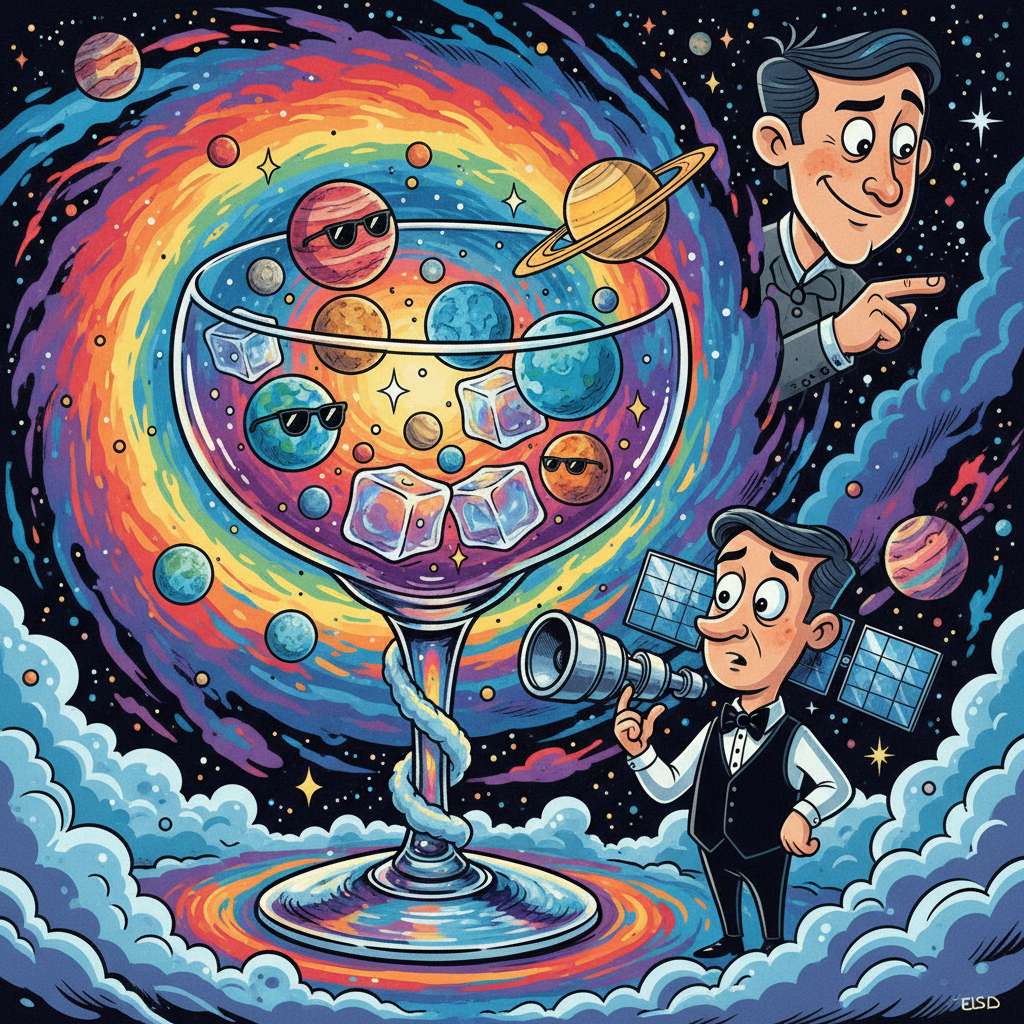
PALOMAR, CA – In a groundbreaking discovery that has left astrophysicists simultaneously awestruck and mildly concerned, the James Webb Space Telescope (JWST) has confirmed the presence of dry ice within the NGC 6302 planetary nebula. This marks the first time solid carbon dioxide has been observed in such a celestial structure, prompting experts to suggest the universe might just be attempting to keep its cosmic beverages cool.
“For years, we’ve been searching for signs of life, or at least the building blocks of it,” stated Dr. Elara Vance, lead researcher for the international team. “But it turns out the universe is just out here, chilling. Literally. We found enough dry ice to keep a galactic-sized kegger going for millennia.” Dr. Vance later clarified that 'kegger' was a 'scientific metaphor' and not an actual prediction of extraterrestrial frat parties.
The discovery, detailed in a pre-print paper, has shifted the focus for some astronomers. “We used to think about star formation and black holes,” commented Dr. Kaelen Thorne, a theoretical astrophysicist not involved in the study. “Now, I’m picturing nebulae as giant, cosmic coolers, just waiting for someone to bring the interstellar punch. It really puts the 'party' in 'particle physics.'”
Critics, however, questioned the JWST’s priorities. “Billions of dollars for a space telescope, and all it tells us is that space has a really good ice machine?” scoffed Senator Mildred Jenkins (R-KY), chair of the Senate Subcommittee on Astronomical Appropriations. “I could have told you that. Just look out a window. It’s cold out there.”
Despite the budgetary concerns, the team remains optimistic. Their next mission: determining if the nebula also contains tiny, cosmic umbrellas for its drinks.