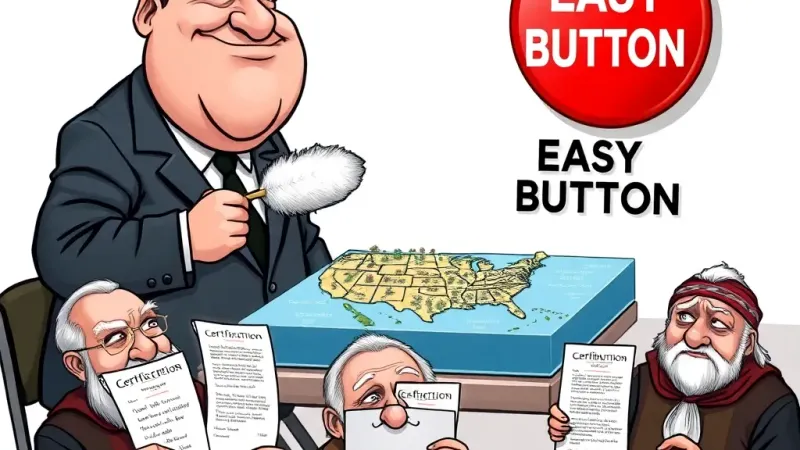
WASHINGTON D.C. – The U.S. Department of the Interior (DOI) announced today the triumphant conclusion of its three-day "Future of Indigenous Asset Distribution & Equity" (FIADE) probate outreach event at the Gila River Indian Reservation, declaring the initiative a resounding success in permanently resolving centuries of complex tribal land ownership disputes. The agency lauded its 'unprecedented' commitment to equity by clarifying property rights for thousands of individuals, ensuring a streamlined future for intergenerational wealth transfer.
"After meticulously outlining the fundamental principles of estate planning over an intense 72-hour period, we are confident that the foundational issues inhibiting equitable land distribution across tribal communities are now definitively addressed," stated Assistant Secretary for Indian Affairs, Dr. Evelyn Thorne, visibly tired but beaming during a virtual press conference. Dr. Thorne highlighted the program's innovative "Probate 101" module, which covered topics ranging from "What is a Will?" to "Navigating Federal Forms SF-219A Through SF-227C for the Contemporary Indigenous Landholder." She added that the 18 DOI specialists involved had consumed "an estimated 47 gallons of coffee and exactly three cases of artisanal sparkling water" during their intensive effort, underscoring the sheer human capital deployed for this groundbreaking endeavor. "It’s truly a testament to what can be achieved when a federal agency dedicates a full three workdays to a problem that has historically taken, you know, a very long time," Thorne added, gesturing vaguely at historical timelines.
Legal scholars were quick to praise the department's agility. "To condense centuries of deeply entrenched, federally-complicated property law and intergenerational transfers into a single, three-day educational sprint is nothing short of a bureaucratic miracle," commented Professor Quentin Fitzwilliam of the Institute for Rapid Policy Implementation Studies. "It sets a new benchmark for governmental efficiency, demonstrating that with enough high-lighters and flip charts, virtually any multi-generational injustice can be streamlined into a manageable workshop format." He projected that this methodology could soon revolutionize other long-standing challenges, like pension reform or perhaps even global climate change, if enough lunch breaks are strategically scheduled.
Local attendees expressed a cautious optimism that the information, once digested, might eventually facilitate clearer land titles. "It was very informative," remarked Gila River Elder Maria Whitefeather, picking at a complimentary DOI-branded stress ball. "They had many slides. It’s good to know how the government thinks about these things. We've mostly been thinking about them since, well, forever." She paused, then added, "Now we just have to figure out how to apply three days of PowerPoints to situations that have been developing over ten generations, especially when the federal forms change every six months."
The DOI plans to celebrate this monumental achievement with a new commemorative stamp, featuring a tastefully blurred image of a stack of federal forms and a tiny, exhausted eagle.