
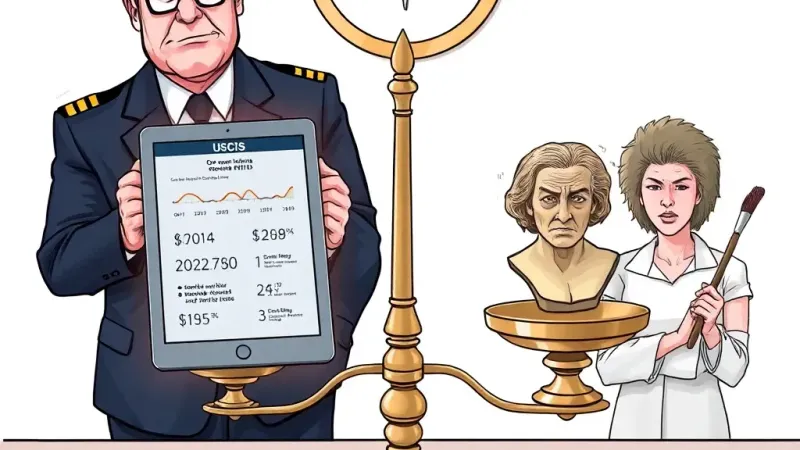
WASHINGTON D.C. — The U.S. Citizenship and Immigration Services (USCIS) announced a groundbreaking reinterpretation of its O-1B “extraordinary artist” visa program today, formally recognizing an applicant’s digital monetization strategy and audience engagement metrics as definitive proof of artistic genius. The move is hailed by some as a necessary update to immigration policy for the creator 2, ensuring the nation attracts top-tier talent in an increasingly digital world.
Under the revised guidelines, applicants for the O-1B visa, historically reserved for individuals with a “demonstrated record of extraordinary achievement” in arts or entertainment, will now find their OnlyFans income, Twitch subscription numbers, YouTube ad revenue, and Patreon tiers weighted heavily. The shift follows a series of successful applications from high-earning digital content creators, with one prominent Colombian-Canadian streamer and adult content model cited as a key precedent, whose substantial platform earnings were instrumental in her O-1B approval.
“The market has spoken, and frankly, it’s a much more efficient arbiter of talent than any panel of dusty academics,” stated Dr. Evelyn Vorkosigan, Director of Digital Talent Acquisition at USCIS, in a private briefing. “Why review abstract portfolios when you can simply verify Q4 earnings? This new framework cuts down on subjective interpretation and frankly, ensures we’re bringing in individuals who can demonstrably contribute to the American 2 in, shall we say, a highly engaged manner.” Vorkosigan highlighted that diversification of revenue streams, such as exclusive content tiers or cryptocurrency tips, will further bolster an applicant’s case under the new “Category 1-B Digital Performance Sub-Classification.”
The update formalizes a long-held suspicion among traditional artists that their craft is increasingly undervalued unless it can be effectively monetized at scale. Industry analysts suggest the shift will particularly benefit those in burgeoning sectors like ASMR performance, bespoke AI art prompt engineering, and hyper-niche micro-influencing. Concerns about the potential for AI-generated content to eventually meet these new ‘engagement’ benchmarks were dismissed, with USCIS confirming that an applicant must still prove they are, in fact, human, at least for now.
This progressive approach from Homeland Security aims to solidify the U.S.’s position as a global hub for innovative digital artistry. Critics, however, note that the policy effectively equates artistic merit with pure financial success, redefining creativity as an elaborate form of digital wealth extraction.
Still, as one unnamed USCIS official put it, “If you can consistently get millions of people to pay you for something, that’s extraordinary enough for us.”
Hambry is a satire publication. All articles are works of fiction.