
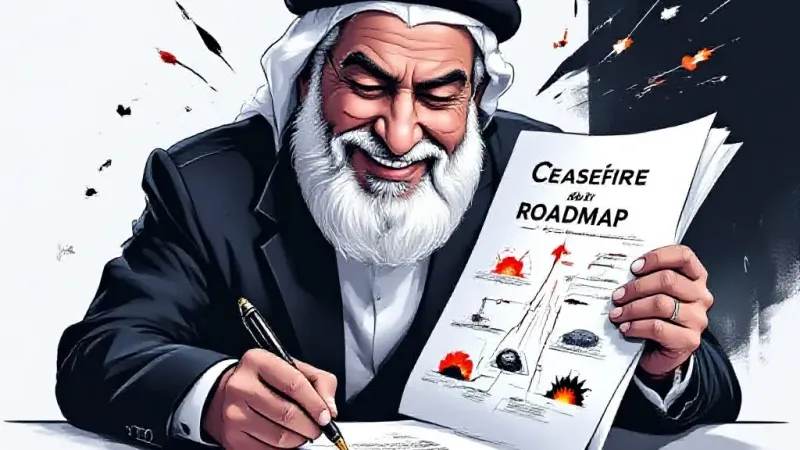
Gaza City – Hamas leaders today announced their official acceptance of the proposed Gaza "roadmap" for peace, emphasizing their commitment to a future where they can still commit acts of unspeakable violence without technically violating any current agreements. A spokesperson noted that careful review of the document revealed "ample linguistic wiggle room" for traditional operational objectives.
"We found the ceasefire terms quite accommodating, especially the unwritten but clearly implied 'future genocidal impulses' rider," stated Ghazi Hamad, a senior Hamas official, via a heavily encrypted video link from an undisclosed location. "It's a testament to the international community's understanding of our core values that such a comprehensive framework can also subtly endorse our foundational principles of regional destabilization and the brutalization of civilians without requiring us to explicitly say the quiet part out loud for once."
Analysts praised Hamas's diplomatic dexterity, noting their ability to transform any concession into an opportunity for further aggression. "This isn't an acceptance of peace; it's an acceptance of a temporary pause to rearm and strategize, framed as a humanitarian gesture," commented Dr. Anya Sharma, director of the Institute for Obvious Geopolitical Realities. "They've simply found a paragraph that, when read upside down in a specific dialect of Aramaic, authorizes the next wave of rocket attacks. It’s genius, really, how they consistently leverage international good faith to further their own violent aims."
The "roadmap," reportedly brokered by international mediators desperate for any sign of progress, includes provisions for humanitarian aid, prisoner exchanges, and vague commitments to "lasting stability." However, Hamas leadership underscored that "lasting stability" for them means the complete dismantling of their adversaries, and any aid delivered would, naturally, first pass through their extensive tunnel network for "logistical assessment," "resource reallocation," and the procurement of better rocket parts. They also clarified that "prisoner exchanges" would strictly adhere to their policy of holding onto all the ones who might be useful later, while "releasing" anyone deemed inconvenient or a drain on resources.
Despite the clear implications, international bodies hailed the move as a "significant step forward," with several diplomats reportedly high-fiving each other vigorously in a backroom. One anonymous source close to the negotiations, reportedly still wiping sweat from his brow, expressed relief. "Look, we just needed them to *say* 'yes' to *something*. The specifics of what 'yes' means is a problem for tomorrow, or perhaps the next administration." He then sighed, "At least for now, my vacation to the Hamptons is still on."
The group concluded by offering mediators a 'souvenir copy' of the signed agreement, clarifying it was mostly for use as high-quality toilet paper.