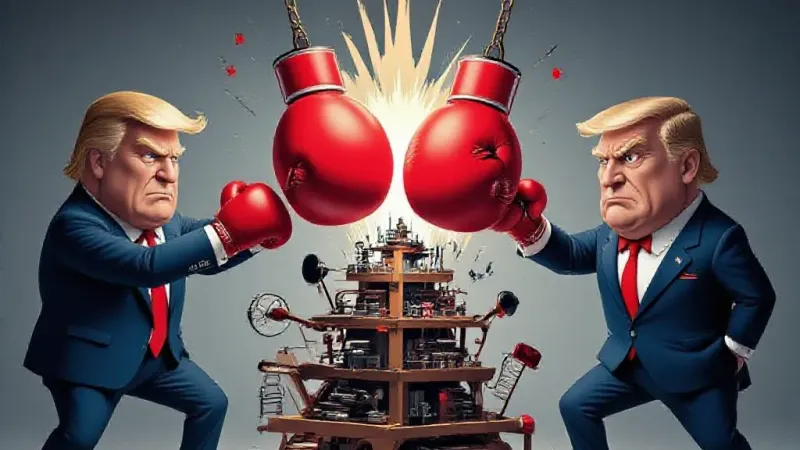
Washington D.C. — Geopolitical strategists and regional analysts have reportedly issued a stark warning to both the United States and Iran, cautioning that their ongoing exchange of military actions in the Middle East is demonstrably leading to an increase in military actions. The groundbreaking revelation comes after months of missile strikes, drone attacks, and proxy skirmishes, which, according to the analysts, seem to be generating further missile strikes, drone attacks, and proxy skirmishes at an alarming rate.
"It's like they thought 'calibrated response' was some kind of de-escalation spell," stated Dr. Amelia Finch, Director of the Institute for Unforeseen Consequences at Georgetown. "Our predictive models, which are mostly just historical records and basic arithmetic, strongly suggest that when you hit something, that something might hit you back. Repeatedly. We've been tracking these developments for years, and the data consistently points to a direct correlation between 'launching a weapon' and 'a weapon being launched back.' It’s a feedback loop, not a one-way street, and frankly, the complexity level here is barely above 'if you poke it, it might bite.'" Finch added that her team had to recalibrate their "Duh-O-Meter" multiple times this week, as the obviousness of the situation kept pushing it past its maximum setting, forcing them to consider a 'Seriously, Guys?' upgrade.
Sources within the Pentagon, speaking on condition of anonymity, admitted the findings were "unexpectedly linear" and "a bit of a buzzkill." One senior official reportedly mumbled, "We assumed the enemy would eventually just get bored, run out of stuff to shoot, or maybe switch to strongly worded letters. Nobody briefed us on the 'escalation means more escalation' scenario. That’s an advanced module they usually save for like, fourth-year diplomacy students, right after 'how to correctly fold a flag' and 'never trust a peace treaty.'" Meanwhile, Iranian state media lauded their nation's "strategic patience" in repeatedly responding to attacks with more attacks, proving their unwavering commitment to a "measured, yet perpetually re-measuring" posture, which they assured citizens was "absolutely not accelerating anything."
The analysts’ report, published by the newly formed Center for Stating the Obvious, reportedly concluded that a wider, uncontrolled war remains a distinct possibility, especially if both nations continue to pursue what they describe as "controlled chaos" that repeatedly loses control. They urged both Washington and Tehran to consider the radical notion of "not doing that," suggesting that a return to negotiations might involve less throwing of expensive hardware and more talking, a concept they acknowledged might be "entirely foreign" to current foreign policy playbooks. "Sometimes," Dr. Finch later clarified in a follow-up memo, "the 'wake-up moment' is just realizing you're in bed with a bunch of toddlers throwing breakfast."
Both nations confirmed they are carefully reviewing the analytical findings and are currently debating whether the best response is a strongly worded press release or another strategically calibrated missile strike.