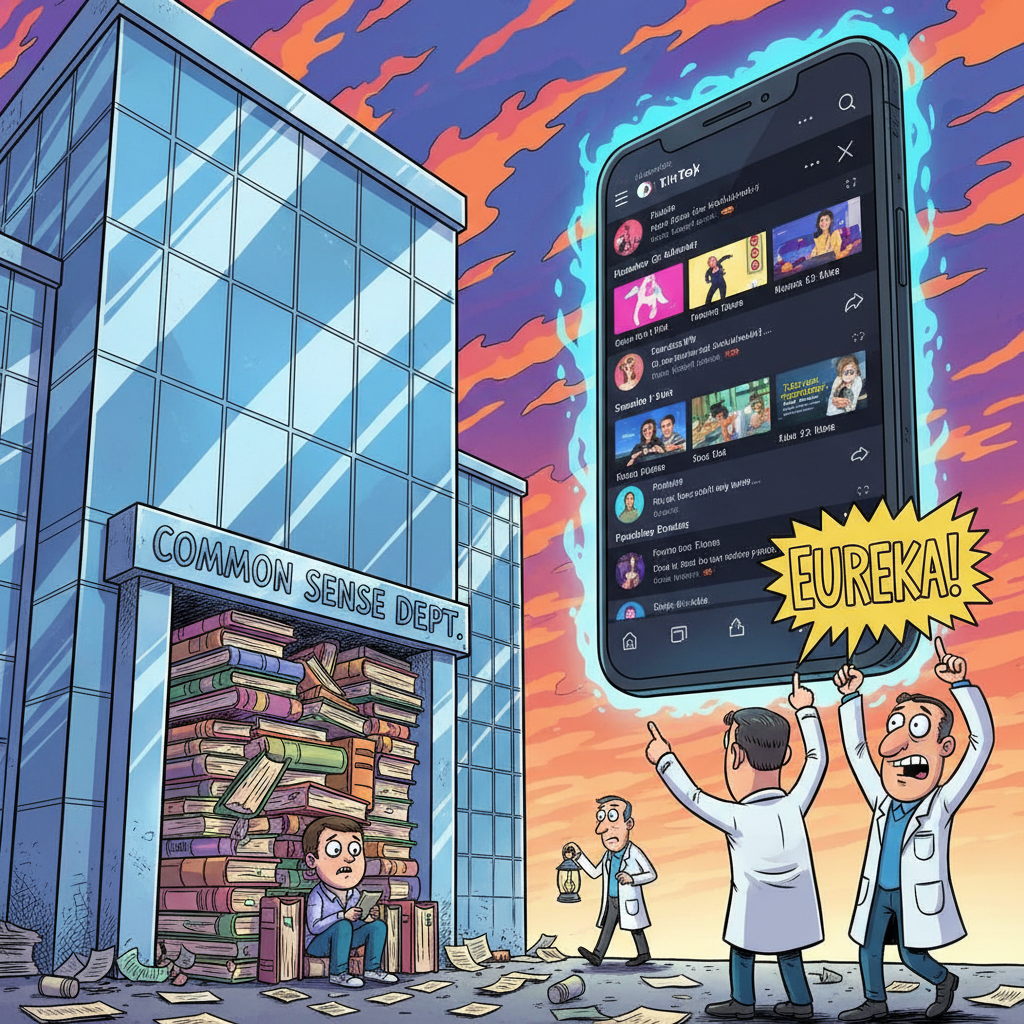
LAWRENCE, KS — In a stunning revelation that has sent ripples of 'no duh' across academia, a new study from the William Allen White School of Journalism & Mass Communications at the University of Kansas has definitively linked lower self-control in students to an increased likelihood of procrastinating with short-form video content.
The multi-year research, funded by an undisclosed grant, meticulously observed thousands of college students, concluding that those who struggled with impulse regulation were more prone to choosing endless digital scrolls over, say, writing a term paper. “Our data clearly indicates a statistically significant correlation between the desire to escape immediate responsibilities and the consumption of 15-second dance routines,” stated lead researcher Dr. Evelyn Ponder, adjusting her glasses with an air of profound discovery. “It appears the human brain, when faced with a difficult task, often opts for the path of least resistance, especially if that path involves a cat playing the piano.”
University officials lauded the study as a crucial step in understanding modern student behavior. “This research finally provides empirical evidence for what we’ve all intuitively known since the invention of the internet: screens are distracting,” said Dean Arthur Finch, who admitted to briefly checking his phone during the press conference. “Now, we can begin to develop strategies, perhaps involving… stronger Wi-Fi signals in study areas?”
Students interviewed for the study expressed overwhelming agreement. “Yeah, no kidding,” commented sophomore Maya Rodriguez, mid-scroll. “Wait, what was the question again?”