WASHINGTON D.C. — In a bipartisan move addressing what officials have quietly deemed a "silent national crisis," the federal government today announced the formation of the Bureau of Broadcast Locators (BBL), a new agency dedicated to helping Americans find which channel or streaming service is actually showing their local sports team’s game. The initiative comes after years of escalating fan frustration over fragmented media rights, increasingly opaque blackout rules, and the sheer computational effort required to watch a regional sporting event.
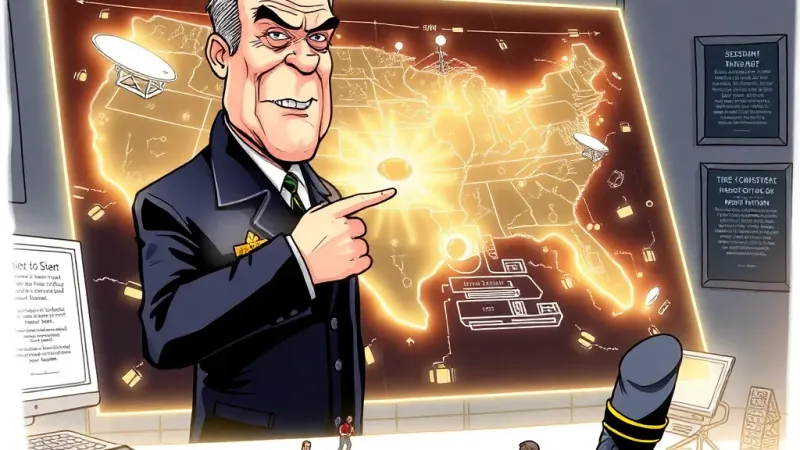
"For too long, the simple act of watching your hometown heroes play has become an Olympic-level exercise in media archaeology," stated Director Bethany Thorne, head of the new BBL, at a press conference that included a 17-slide PowerPoint presentation detailing common fan search queries like "Is the Reds game on Hulu Live this week or is it still on Bally Sports Ohio, or did Spectrum finally get it?" Thorne highlighted a recent study by the fictitious Institute for Applied Leisure 2, which found that the average American spends 37 minutes per week attempting to locate a broadcast, often resulting in "digital fatigue and mild 2."
The BBL's initial rollout includes a 24/7 hotline staffed by media rights specialists, an AI-powered website that promises to "algorithmically parse your specific geo-location, subscription bundle, and karmic alignment" to deliver a single, definitive answer, and a series of mandatory public service announcements explaining the nuances of in-market vs. out-of-market blackouts. Early feedback suggests the AI’s most frequent response is a cryptic "Have you tried looking out a window and imagining the game?"
Dr. Evelyn Reed, a leading expert in contemporary media fragmentation at the University of Fictional Studies, lauded the government's intervention. "We've reached a point where the only way to guarantee you'll see your preferred game is to either own the broadcasting company or somehow physically manifest at the stadium, preferably having bought the most expensive corporate box package," Dr. Reed explained. "The BBL acknowledges the brutal reality that streaming wars and corporate mergers have effectively turned local sports into a series of highly volatile, pay-per-view hostage situations, with the fans' loyalty as the ransom."
Critics, primarily composed of cable providers and streaming service executives, argue that the BBL is an unnecessary intrusion into a thriving, if slightly competitive, market. However, a spokesperson for the National League of Fan Engagement (NLFE) countered, "When you need a federal agency to explain why you can't watch a game played three miles from your house, it's pretty clear the 'market' has achieved terminal velocity into pure, unadulterated chaos."
The BBL estimates that its services will reduce fan broadcast-search time by up to 12% in its first year, preventing an estimated 4.3 million hours of collective sighing. The agency also plans to launch a "Know Your Blackout Rights" educational campaign and a "Neighborhood Broadcast Exchange" program, where fans can literally trade obscure streaming passwords in designated public spaces. "Our goal," Director Thorne concluded, "is to ensure that no American misses a crucial seventh-inning stretch because they spent too long in a dark, algorithmic cul-de-sac. We believe that access to locally relevant athletic entertainment is a fundamental, albeit incredibly complex, human right." The bureau’s next project is reportedly a multi-year effort to understand why their grandmother still watches only one channel.