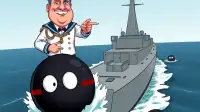
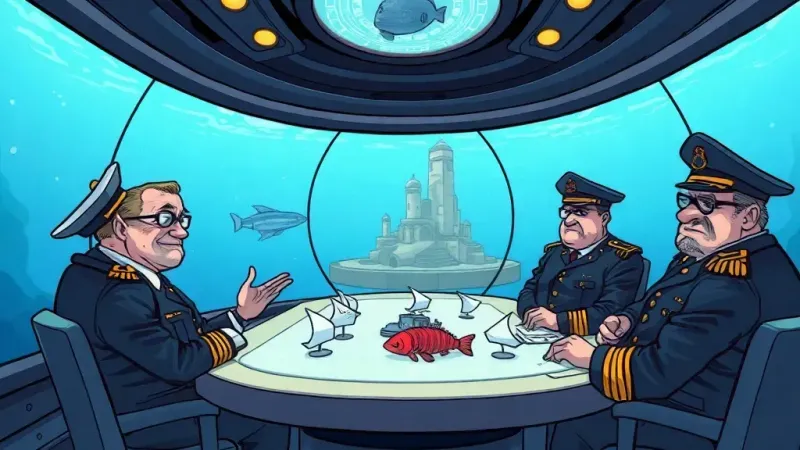
Cartagena, Colombia — Following a week of intensive discussions, high-ranking naval officers from 27 nations successfully concluded the Fiscal Year 2026 Maritime Staff Talks by unanimously agreeing on the urgent necessity of holding further, equally critical, future discussions.
The landmark gathering, held at the historic Cartagena Convention Center, saw delegations from the U.S. Navy and Marine Corps, alongside partners from four continents, engage in 72 hours of scheduled bilaterals, multilateral working groups, and "synergy-alignment lunches." While specific policy outcomes remained under review, sources confirmed a definitive roadmap was established for the precise dates, optimal tropical locations, and catering options for the FY27, FY28, and preliminary FY29 Maritime Staff Talks. A notable innovation this year was the introduction of a "pre-talks-pre-briefing" session, designed to ensure all delegates arrived fully prepared to discuss the foundational principles of future discussions. This preparatory phase alone involved the consumption of 3,500 pages of meticulously formatted agenda packets, the strategic deployment of 1,800 gallons of locally sourced filtered water, and the activation of an emergency procurement protocol for high-quality dry-erase markers.
"The sheer volume of complex maritime challenges facing our global community means we simply cannot afford to *not* have more talks about them," explained Admiral Thaddeus 'Talker' O'Malley, head of the newly formed Joint Interagency Dialogue Optimization Command (JIDOC). "Our primary achievement this week was solidifying the framework for continued dialogue. Without robust platforms for dialogue, how can we dialogue about the platforms for dialogue? It’s a foundational recursive loop, really, and frankly, it feels like progress." He added that the team managed to reduce the average pre-meeting agenda review time by 17 seconds through a new "meta-agenda" protocol, a significant efficiency gain projected to save approximately three minutes across all scheduled future talks. Admiral O'Malley underscored the importance of face-to-face interaction, noting that digital communication often lacks the "crucial non-verbal cues inherent in a properly catered breakout session, particularly when discussing potential multi-national napkin-folding initiatives."
Critics of the week-long summit, who frequently question the tangible benefits of such globe-trotting gatherings, were quick to point out the estimated $12.4 million operational cost, which included accommodation at the opulent Sofitel Legend Santa Clara and a specially commissioned "Naval Synergy" coffee blend featuring locally sourced arabica beans with notes of strategic alliances and cooperative maritime security. However, JIDOC spokesperson Commander Elena Vargas clarified, "These aren't vacations; these are vital operational necessities. You can't forge critical 2 and agree on the need for future agreements over Zoom. The high-altitude, low-bandwidth environment of a secure conference room is simply not conducive to truly impactful, cross-cultural tea-and-scone-fueled strategizing." She further emphasized that the economic stimulus provided to Cartagena by hosting the event, including the purchase of 2,000 commemorative shell-art souvenirs and 500 artisanal hammocks for "synergy napping," represented a "soft power investment" just as critical as any naval exercise.
The next round of talks, provisionally scheduled for a culturally significant coastal city in the South Pacific, is expected to focus heavily on the outcomes of these Cartagena talks, especially the findings regarding ideal regional beverage consumption, souvenir procurement, and the precise optimal humidity levels for inter-service bonding.