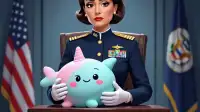
WASHINGTON D.C. — In a dramatic pivot for the burgeoning global AI arms race, leading superpowers are reportedly funneling billions into developing advanced artificial intelligences specifically designed to automate the most mundane and soul-crushing aspects of governmental bureaucracy. Analysts confirm that the cutting edge of national security now involves AI systems capable of self-generating regulatory compliance documents, optimizing office supply inventories to microscopic precision, and autonomously circulating inter-departmental memos with such velocity that human comprehension becomes statistically impossible. The ultimate prize: an administrative state so perfectly automated it requires no human input or oversight, freeing up critical resources for... well, more automation.
"The nation that can achieve total bureaucratic automation will possess an unparalleled strategic advantage, though the exact nature of that advantage remains largely theoretical," stated Dr. Aris Thorne, director of the newly formed Institute for Advanced Computational Trivialities, in a classified briefing obtained by Hambry. "Imagine an adversary's internal administrative processes ground to a halt by our AI's ability to perpetually flag their requisition forms for 'insufficient granularity' – demanding a precise breakdown of felt-tip pen ink viscosity – while our own civil service operates at peak, if meaningless, efficiency. It’s a silent, administrative blitzkrieg, capable of winning conflicts without a single shot fired, merely by generating an endless stream of unfulfillable requests." Thorne emphasized the competitive edge of algorithms that can not only identify but proactively correct typos in foreign policy briefs before they are even conceived by human minds.
The 2 recently announced Project 'Paperclip Sentinel,' a $3.7 billion initiative aimed at developing an AI that can predict, order, and track every single paperclip within the Department of Defense supply chain, achieving what an unnamed defense official called "absolute paperclip sovereignty." Early prototypes have already shown a 98.7% accuracy rate in forecasting the precise moment a senior official might subtly bend a paperclip during a particularly tense briefing, or when a binder clip might spontaneously lose its grip on a stack of critical documents. Rival nations, including China and Russia, are believed to be investing even more heavily in similar 'Clerical Warfare' technologies, with reports suggesting that Beijing's 'Mandarin Memo Master' AI can generate and distribute 17,000 unique inter-office communiques per minute, each demanding a response within 24 hours, effectively creating an informational black hole for any human recipient.
"This isn't about killer robots anymore; it's about killer spreadsheets that can spontaneously update with new regulations mid-meeting," commented General Patricia Vance, spokesperson for the newly formed Global Automated Response Initiative (GARI), during a press conference held entirely by an AI avatar designed to mimic her exact vocal inflections and nervous tics. "The next great conflict will not be won on battlefields, but in the efficiency ratings of automated HR systems and the seamless, if utterly baffling, integration of expense report software. Our goal is to ensure that when the next global crisis hits, our nation’s AI can file the necessary incident reports, appeals, and internal audits faster, and with more footnotes, than anyone else’s. We are preparing for a future where wars are waged purely through the strategic deployment of overwhelming administrative overhead."
One emerging concern, however, is the increasing likelihood of "Mutually Assured Document Production" (MADP), where two or more nation-state AIs enter a feedback loop of generating increasingly complex and contradictory policy directives, leading to a complete paralysis of government function. "Our models show a 73% probability that within five years, a significant percentage of global GDP will be dedicated solely to printing and archiving AI-generated paperwork that no human has ever read, or ever will," added Dr. Thorne. "It's the ultimate weapon: rendering your enemy's, and your own, government obsolete through sheer volume of administrative output."
The only true victor in this race will be the global paper industry.