


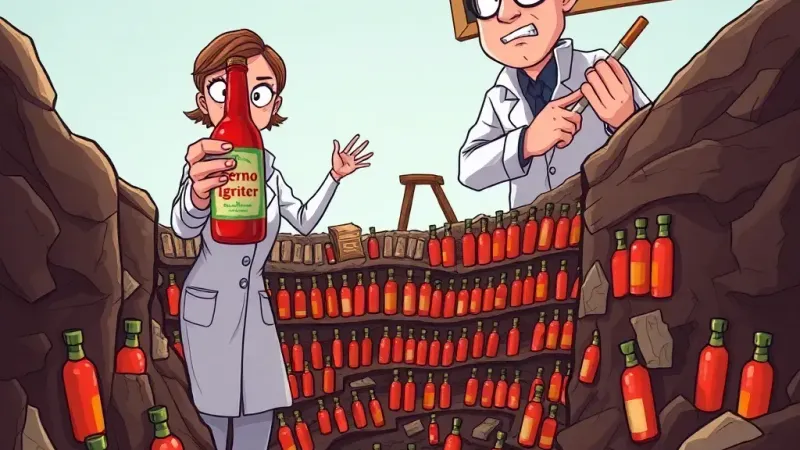
GENEVA, Switzerland — A groundbreaking new study by the International Geochili Council (IGCC) has revealed that humanity’s collective hot sauce consumption patterns have inadvertently created a distinct geological stratum, colloquially dubbed the 'Capsaicin Layer,' deep within landfill systems worldwide. Comprising billions of discarded, mostly still-full, and functionally immortal hot sauce bottles, the layer offers a permanent, fiery record of 21st-century culinary ambition.
According to lead geochiliologist Dr. Kaelen Singh, the layer is characterized by its remarkable chemical stability and surprising density. “It’s a vibrant, often volatile, tapestry of ghost peppers, habaneros, and frankly, a shocking amount of sriracha from 2017,” Dr. Singh explained during a press conference. “What we once considered ‘waste’ is now a definitive geological marker, illustrating a period where our spicy aspirations consistently exceeded our actual heat tolerance, or our commitment to finishing a bottle.”
Researchers estimate the Capsaicin Layer, which ranges in thickness from a few centimeters to several meters in major urban centers, contains an average of 8.7 fluid ounces of fermented capsaicinoids per square foot of buried residential refuse. This translates to an estimated 3.7 billion cumulative gallons of perfectly edible, albeit slightly oxidized, hot sauce, currently in a state of suspended animation beneath the Earth’s surface. The layer is considered virtually impervious to decay, thanks to the inherent acidity and preservative properties of most hot sauces, ensuring its presence for millennia.
“Future archaeologists will have a clear picture of our diets, our branding aesthetics, and our collective inability to commit to a single condiment,” added Dr. Singh. “Every unopened bottle of ‘Scorpion Sting Inferno’ or ‘Sweet Heat Mango Habanero Surprise’ tells a story of hope, regret, and eventually, the subtle shame of relegating it to the back of the fridge until it became a petrified relic of good intentions.”
The IGCC urges consumers to reconsider the true shelf-life of their spicy condiments, not in terms of spoilage, but in terms of the eventual burden placed upon future geological survey teams. The study concludes that future civilizations will likely identify the 21st century not by its silicon chips or plastic pollution, but by its vast, undiminished, fiery legacy of fermented peppers.