
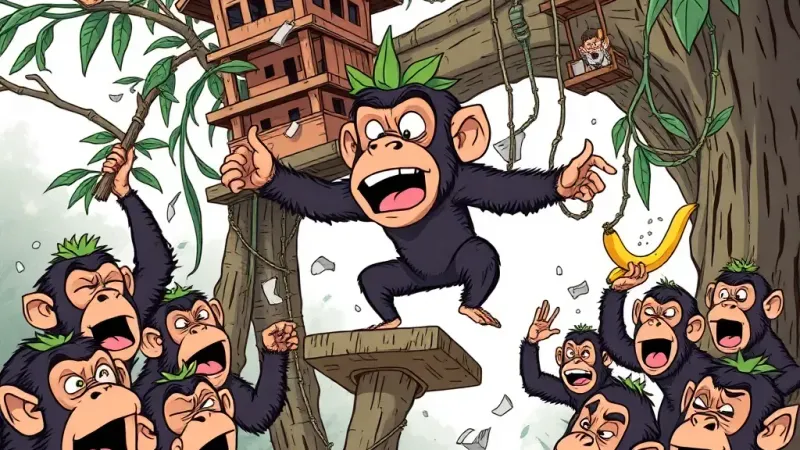
The largest known association of wild chimpanzees has officially fractured, with scientists citing a catastrophic failure in scalable governance and an inability to adapt hierarchical structures to burgeoning population demands. After decades of unprecedented growth and apparent stability, the approximately 130-member super-colony, previously observed thriving in Uganda’s Ngogo forest, has irrevocably split into two hostile factions following sustained periods of internal strife and violent intergroup skirmishes. The findings, published this week in *2*, offer a stark assessment of the inherent challenges in maintaining large-scale social cohesion, even among species not burdened by electoral cycles or fiscal quarter reports.
Researchers from the University of Texas at Austin and various global institutions meticulously documented the breakdown, which they attribute to escalating resource allocation disputes and a critical breakdown in synergistic fruit-gathering initiatives. "What began as minor ideological disagreements over prime foraging territories and optimal grooming rotation schedules eventually escalated into an irreconcilable schism," explained Dr. Aris Thorne, a senior socio-primatologist at the Institute for Comparative Social Dynamics. "Their foundational social contract, while effective at a smaller scale, proved woefully inadequate for managing the complexities of a multi-generational, triple-digit population. There simply wasn't a robust framework for conflict resolution that could scale with their ambitions.
The split involved significant internal displacement and a series of brutal, highly territorial engagements, demonstrating what primatologists are now calling "the inevitable triumph of tribalism over pan-colony aspirations." The two emerging entities, provisionally dubbed the 'Northern Leaf-Nesters' and the 'Southern Ground-Dwellers,' have since established hard borders, with all attempts at re-integration failing amidst continued low-level hostilities. Analysts suggest the Ngogo chimpanzees' rapid expansion, fueled by abundant resources and effective security protocols against rival groups, ironically sowed the seeds of their own demise by creating an unwieldy bureaucracy of dominant males and complex social hierarchies that ultimately proved unsustainable.
"It’s almost depressing how familiar this looks," Dr. Thorne added, gesturing at a detailed infographic depicting chimp territorial incursions. "They had a good run, a real empire for a while. But the minute they hit a certain complexity threshold, it was all over. It makes you wonder if every large, successful social structure, human or otherwise, is just perpetually on the verge of splintering. The dream of a unified super-colony, capable of indefinite, peaceful expansion, remains exactly that: a dream."
The primate community is now cautiously observing the long-term impact of the split, with some prognosticators openly speculating whether the fractured factions will eventually consolidate smaller, more manageable groups or continue their downward spiral into further fragmentation.
Even with unlimited bananas, maintaining a truly global peace was apparently too much to ask.