


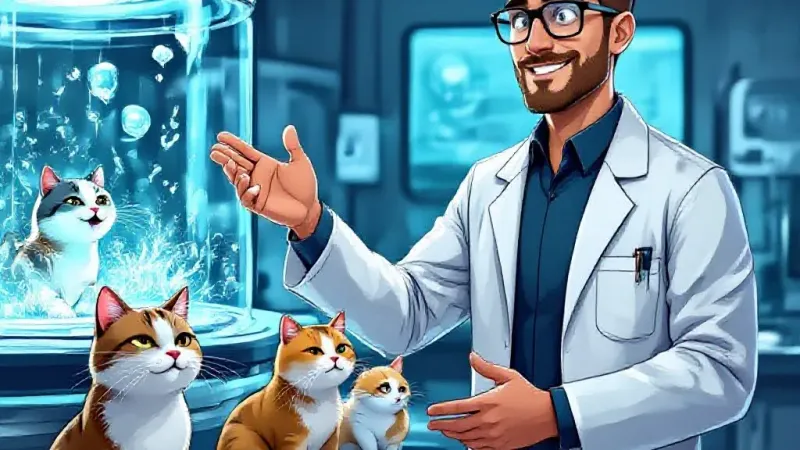
A groundbreaking study published this week has fundamentally redefined the relationship between humans and their feline companions, revealing that house cats' core evolutionary purpose is not companionship, but rather to serve as living, breathing, furry diagnostic tools for human cancer research. Scientists have found startling genetic commonalities between feline and human tumors, effectively turning every purring lap-cat into a biological early warning system.
"For generations, we've admired their grace, their aloofness, their uncanny ability to knock glasses off tables," stated Dr. Aris Thorne, Director of the newly formed Institute for Interspecies Oncology & Human Self-Preservation. "But what we've misunderstood is their true, selfless mission: to develop intricate forms of cancer so we can study them without having to subject ourselves to the indignity. They are, in essence, our biological canaries in the coal mine, but with better grooming habits." Dr. Thorne's team's unprecedented genetic mapping of feline cancers highlighted nearly identical cellular pathways found in human malignancies.
The findings suggest that every cuddly kitty, from the pampered Persian to the scruffy alley cat, is unknowingly participating in a massive, distributed, and highly effective research network, diligently incubating various pathologies for the benefit of their human overlords. Pharmaceutical companies are already pivoting research budgets, with several major players now developing advanced 'feline-specific' treatments that, once perfected, can be reverse-engineered for human application. "It's a win-win," commented a spokesperson for Pfizer-BioNTech, currently fast-tracking a new compound initially designed to give a cat 20 more years of life, which, they add, "is exactly 19.5 years longer than any human wants to spend with a cat anyway."
Future cat ownership guidelines are expected to include mandatory tumor screenings, with pet adoption agencies potentially offering "optimized" felines pre-disposed to certain cancer types for targeted research. Pet insurance providers are reportedly thrilled, forecasting a boom in "pre-clinical trial" coverage, ensuring that your pet's noble sacrifice is financially streamlined. The implications are profound, redefining "pet love" into a more transactional, yet undeniably vital, exchange.
So next time your cat demands an unscheduled meal or knocks your coffee cup over, remember you're not just tolerating a pet; you're nurturing a tiny, furry, highly efficient medical research asset whose life's work is quite literally ensuring yours.