
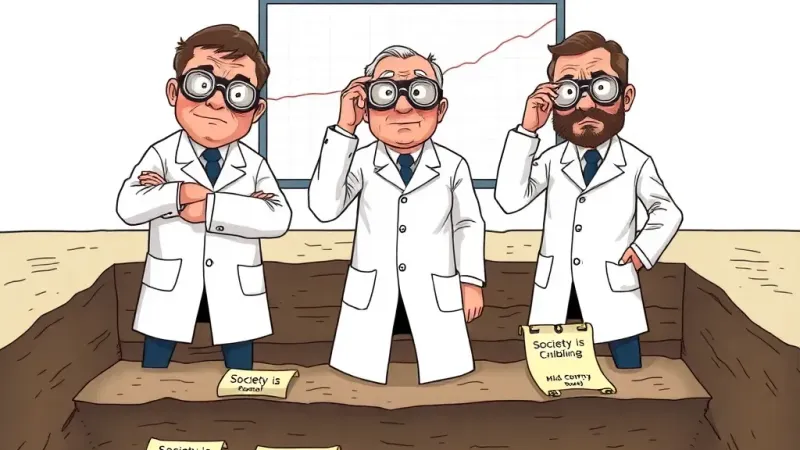
A consortium of leading historians and social scientists announced today that a comprehensive new study confirms what many have long suspected: people throughout recorded history have consistently believed their society was on the precipice of collapse. The findings, published in the *Journal of Historical Lamentations*, reveal that anxieties about societal decay, moral decline, and the perceived inferiority of younger generations are not, in fact, unique to the modern age but are rather a deeply ingrained, almost universal human experience.
Researchers at the Institute for Perennial Grievances, funded by the Minerva Foundation for Universal Discontent, analyzed thousands of ancient texts, philosophical treatises, and personal letters from civilizations spanning Sumeria to late-stage Rome. Their meticulous work unearthed an overwhelming pattern of self-professed historical exceptionalism, where each generation firmly believed it was living through the 'worst of times' and that previous eras were undeniably superior. This groundbreaking discovery challenges the widely held assumption that human beings might, at some point, have simply enjoyed their present.
"We discovered that from the Sumerians lamenting youth 2 to Cicero's exasperated gripes about Roman 2, the fundamental human experience of grumbling about the 'good old days' is remarkably consistent," stated Dr. Elara Vance, lead researcher and Professor of Historical Pessimism. "Essentially, it turns out people just really love thinking things are worse now than they used to be, even when 'now' was 300 BC. The data is unequivocal: for millennia, humanity has collectively believed it was experiencing an unprecedented downturn, even when simultaneously inventing aqueducts and functional sewage systems."
The study highlights specific instances, such as an Egyptian scribe from 2000 BCE bemoaning the lack of respect for elders, a Greek philosopher from 400 BCE decrying the decline of civic virtue, and a Roman poet in 100 CE expressing despair over the impending doom of the empire. According to the research, these sentiments are statistically indistinguishable from contemporary 2 posts about inflation, AI, and the general state of current 2.
The implications of the study are profound, potentially reshaping how historians understand collective human psychology and providing a comforting, albeit bleak, perspective for those currently convinced the world is irrevocably broken. Future research will reportedly investigate whether ancient peoples also found it hard to get out of bed on Mondays.
Hambry is a satire publication. All articles are works of fiction.