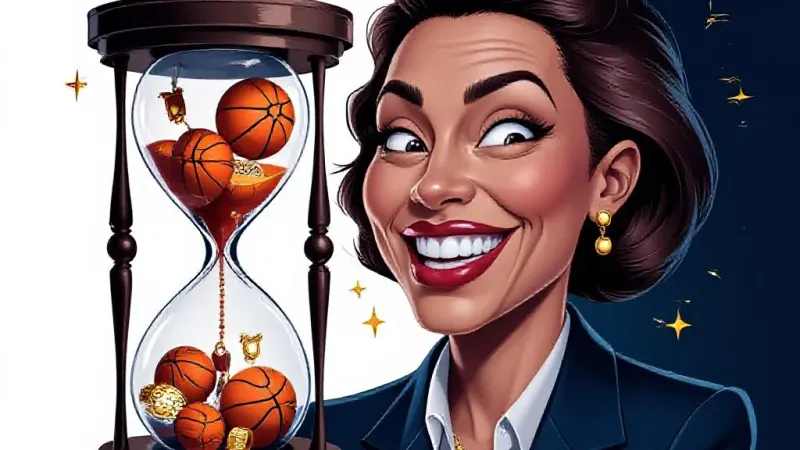
A groundbreaking new study from the Institute for Aspirational Proximity Studies (IAPS) has confirmed that while 87% of self-identified sports enthusiasts claim to be “following the WNBA very closely,” a staggering 92% cannot name a single player currently active in the league. The study, which surveyed thousands of individuals who had at some point used the phrase “I really need to watch more women's basketball,” found a severe disconnect between stated intention and actual recall.
Researchers noted that “engagement” often spiked briefly during major news cycles, such as an athlete's viral moment on social media, a contentious social media post, or an Olympic year, only to plummet back to baseline levels once the immediate cultural obligation to “care” had passed. “It's a phenomenon we're calling 'Vicarious Allyship Aphasia',” explained Dr. Brenda Vance, lead researcher at IAPS, known for their seminal work, “Why You Only Know One Song By That Band.” “People genuinely *want* to be seen as supporters of women's sports, but the actual retention of player names, team rosters, or even which city has a team, seems to activate a powerful mental block that clears up miraculously if a male athlete is mentioned.”
The study outlined a clear pattern: respondents could often recall a singular, widely publicized name from an NCAA championship run, but struggled to connect that name to a professional team or any other individual in the league. When pressed, many resorted to generic praise like, “They're just so good, all of them, especially the tall ones,” or “The talent is incredible across the board, truly, you can just tell by their athleticism.” One respondent, Chad “Sports Guy” Peterson, 38, from Toledo, stated, “I respect the hell out of those women. Total ballers. They got… you know… the one with the hair. You know who I mean. She dunks, right?” Peterson later admitted he had never actually seen a WNBA game, but “saw a highlight on TikTok once, I think.”
IAPS also found a strong correlation between claiming WNBA viewership and the perceived social desirability of “being a good ally.” Participants who believed their responses were anonymous reported significantly lower engagement and name recall, often confusing the WNBA with college basketball or even the Olympics. “It seems many are less interested in the actual sport and more in the moral credentialing it provides,” Dr. Vance added. “The league could host a championship game between the New York Liberty and the Las Vegas Aces, and these fans would still struggle to identify the starting five, much less who won last year. But they'll tell you 'women's sports deserve more attention' right after they finish their fantasy football draft.”
The findings suggest that for a significant portion of the population, “supporting women's sports” is less about actual viewership and more about a vague, performative intention, ensuring that while everyone agrees the WNBA is “great,” few are actually checking the box scores. It’s a collective shrug that allows everyone to feel good about themselves without having to learn a single player's name or commit to watching a full game.