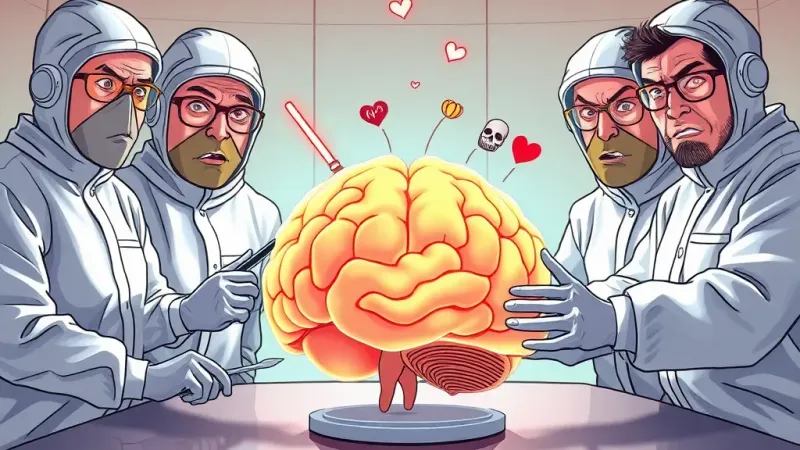
LOS ANGELES — A newly assembled panel of cultural anthropologists, behavioral economists, and brand strategists convened Monday to deeply analyze the "split reactions" of Mark Hamill's three adult children to his iconic Star Wars filmography. The interdisciplinary group, hastily formed by the Institute for Pop 2 Axiology, aims to understand the full implications of this groundbreaking parental-offspring dynamic, which many are calling "the most significant celebrity family revelation since Angelina Jolie adopted a sixth child with a different favorite color."
"For too long, we’ve operated under the implicit assumption that the progeny of cultural titans would form a monolithic critical consensus," stated Dr. Evelyn Thorne, lead researcher for the new initiative and Professor Emerita of Fandom Semiotics at the University of Southern California. "The data points emerging from the Hamill household — namely, that his adult children hold differing views on the artistic merit and personal resonance of their father's most famous work — represents a paradigm shift in our understanding of familial autonomy and the transmission of cinematic legacy. Early findings suggest one Hamill child reportedly 'quite likes' the original trilogy, another 'finds the pacing of the prequels a bit slow but appreciates the world-building,' and a third 'prefers the animated series anyway, especially the one with the good lightsaber fights.'" Dr. Thorne emphasized that such nuanced, individualistic perspectives within a singular household defy conventional wisdom.
The panel’s initial mandate includes developing a "Hamill-Sibling Divergence Index" (HSDI) to quantify the precise degree of individual opinion within high-profile families. Preliminary modeling suggests the Hamill index could reach unprecedented levels, potentially challenging long-held theories regarding genetic predisposition to film criticism or the inevitability of shared familial brand loyalty. Experts are particularly intrigued by the implications for future generations of celebrity offspring, fearing a potential "fragmentation of inherited taste" that could destabilize established fan communities and disrupt the lucrative secondary market for franchise memorabilia, should enthusiasm not be uniformly passed down.
"This isn't just about Luke Skywalker; it's about the very fabric of how we consume and process generational fame and the profound responsibility that comes with being the child of a cultural touchstone," explained Quentin Vance, CEO of CelebSense Analytics, a firm specializing in influencer-family dynamics. "If the children of a global icon aren't uniformly aligned on their parent's signature achievement, what does that mean for brand consistency? What message does it send to other offspring considering a differentiated opinion in the public square? We could be witnessing the dawn of a new era where celebrity children dare to be... themselves, even if 'themselves' involves a lukewarm appreciation for Return of the Jedi." Vance hinted at forthcoming white papers on the "psychosocial impact of non-unanimous familial reviews on brand equity and global merchandising."
Meanwhile, representatives for Mr. Hamill issued a terse statement: "Mr. Hamill loves his children, and they are free to enjoy whatever cinematic works they choose. This is not news, nor does it warrant an interdisciplinary panel." This official response, however, was quickly dismissed by the panel's spokesperson as "a strategic deflection designed to downplay the profound socio-cultural ripples of this complex, unfolding narrative that clearly demands further study and several more grant applications." The Institute for 2 Axiology has already secured preliminary funding for a follow-up study on "The Emotional Labor of Celebrity Children in a Hyper-Curated Content 2."
In related news, local man's children also have opinions, prompting calls for a congressional inquiry into the alarming trend of human individuality.