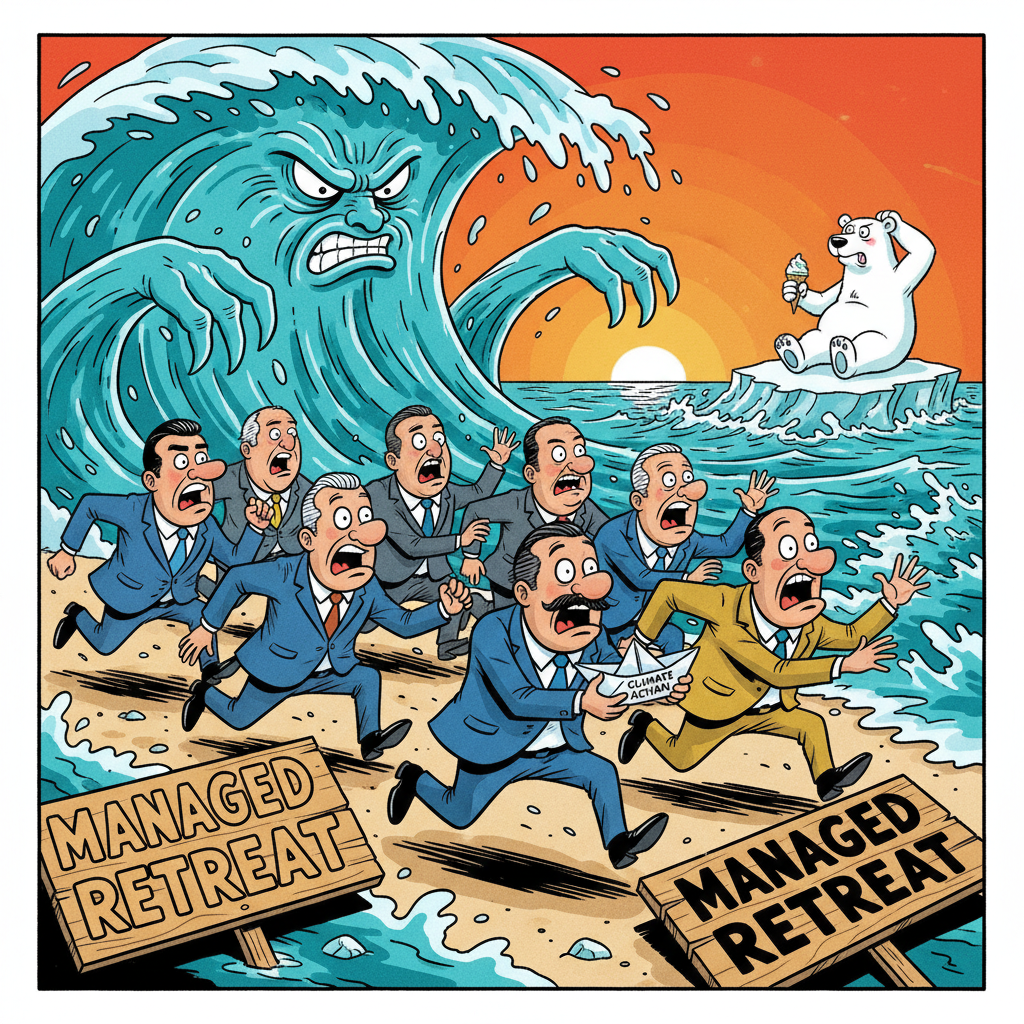
BRUSSELS — European authorities have quietly confirmed that their much-touted 'managed retreat' strategies are, in fact, sophisticated euphemisms for simply packing up and moving when the water gets too high. A groundbreaking new German-Dutch study reveals that the continent is embracing this 'tactical repositioning' far more frequently than previously disclosed, suggesting a continent-wide game of climate-induced musical chairs.
“We’ve found that when faced with an existential threat like a rising sea, the most effective government response is often to just… not be there anymore,” explained Dr. Ingrid Schmidt, lead researcher for the study. “It’s less about engineering a solution and more about engineering a plausible excuse to abandon the problem.” She added that the term 'managed retreat' was chosen for its soothing, corporate-friendly cadence, far preferable to 'mass evacuation' or 'climate-induced panic migration.'
Critics argue that this strategy, while effective at getting people out of harm’s way, does little to address the underlying issues. “It’s like saying your diet plan involves eating whatever you want and then just buying bigger pants,” remarked climate activist Jean-Luc Dubois. “At some point, you run out of new places to put your pants.”
Officials, however, remain steadfast. “We are committed to protecting our citizens, and sometimes that means relocating them to areas where they won’t be constantly battling a vengeful sea,” stated a spokesperson for the European Commission, who asked to remain anonymous while packing a small duffel bag. “Think of it as a proactive, strategic re-homing initiative.”
The study concludes that Europe's future might involve fewer iconic coastal landmarks and more inland, slightly damp, 'managed communities.'