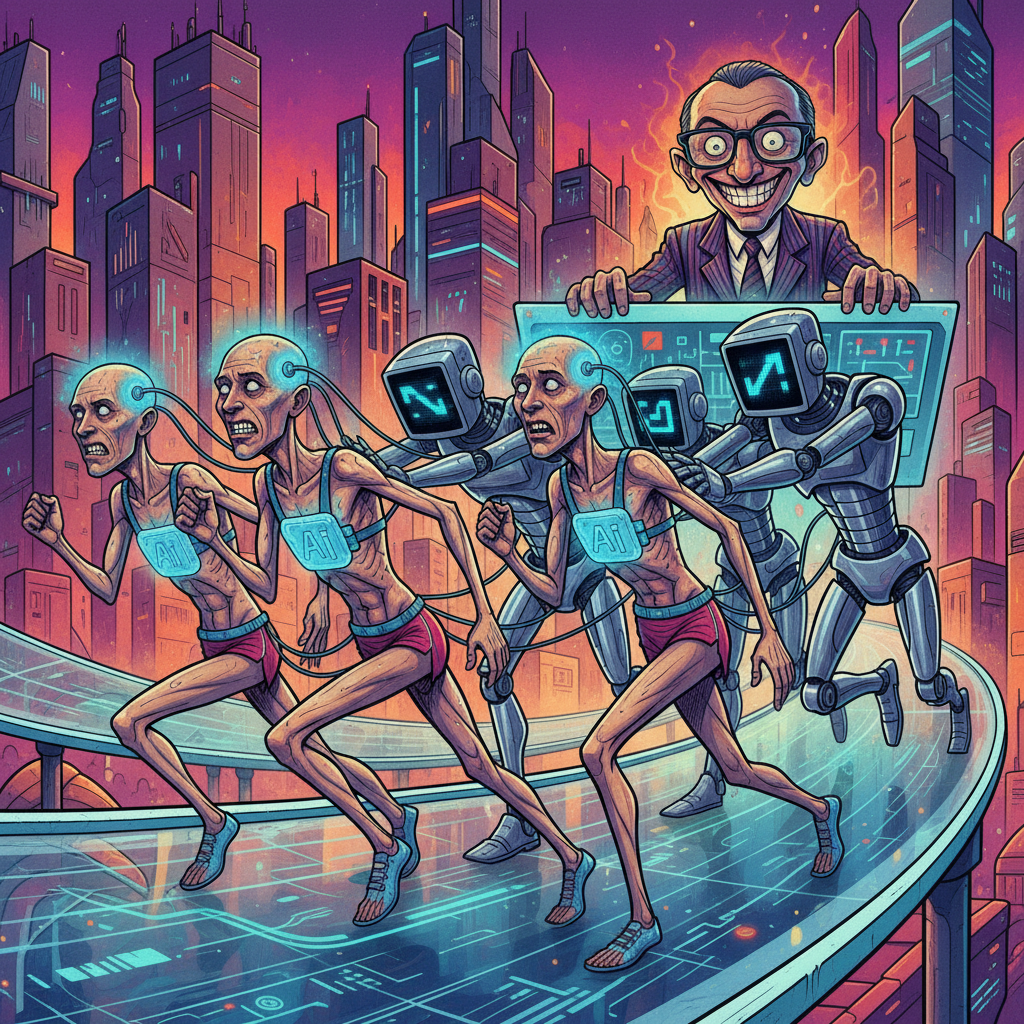
LOS ANGELES, CA — In a groundbreaking move that promises to redefine the limits of human endurance and self-flagellation, a coalition of elite 10K runners has formally petitioned race organizers to mandate AI-powered pacemakers for all future professional events. The athletes argue that relying on fallible human pacers introduces an unacceptable margin of error, preventing them from achieving their absolute fastest, most agonizing times.
“Frankly, human pacers are too empathetic,” stated two-time national champion Brenda 'The Blender' Miller, wiping a bead of synthetic sweat from her brow after a simulated race. “They slow down when they see the pain in your eyes. An AI doesn’t care about your lactic acid levels; it cares about the algorithm. It will push you until your soul leaves your body, and that’s the kind of unwavering commitment we need.”
The proposed AI units, dubbed 'AgonyBots,' would be surgically implanted or worn as non-removable exoskeletons, continuously monitoring biometric data like heart rate, oxygen saturation, and despair quotients. They would then adjust the runner's pace with micro-corrections, ensuring every fiber of their being is operating at precisely 99.9% of maximum capacity for the entire 6.2 miles.
Dr. Aris Thorne, a leading sports psychologist and consultant for the initiative, explained the benefits. “This isn’t about making it easier; it’s about making it perfectly, scientifically hard. We’re removing the 'human element' — things like 'hope' or 'the will to live' — to unlock true athletic potential. Imagine a world where every runner crosses the finish line having left absolutely everything, including their dignity, on the track.”
Critics, primarily composed of former human pacers now facing technological unemployment, have voiced concerns about the dehumanizing aspect of the sport. However, race organizers appear receptive, noting the potential for increased viewership of athletes literally running themselves into the ground.
Sources close to the negotiations suggest that initial trials will focus on optimizing the 'suffering-to-speed' ratio, with early results indicating a 15% increase in both metrics. The future of running, it seems, is less about beating your opponent and more about letting a robot beat you.