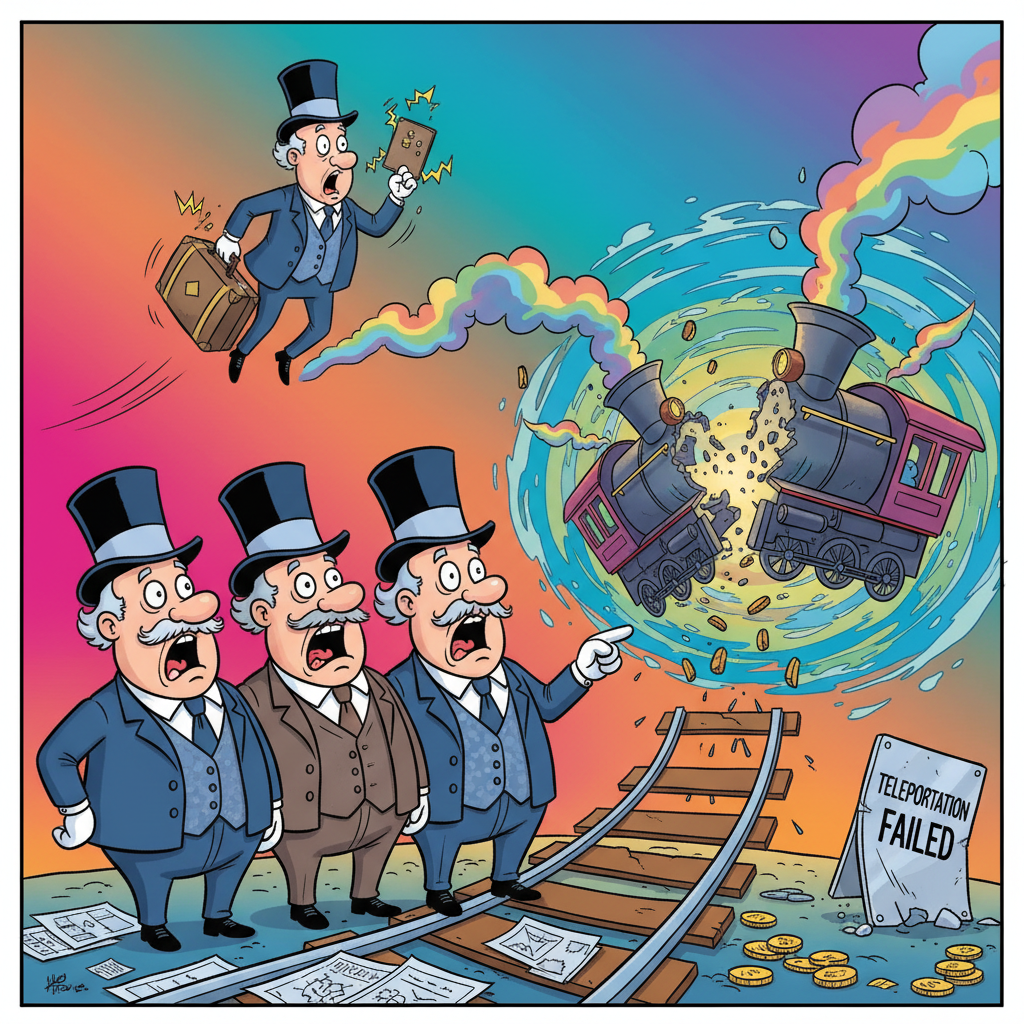
WASHINGTON D.C. – A groundbreaking, albeit belated, realization has swept through the executive suites of America's freight rail industry: trains, it turns out, require tracks. This stunning discovery comes after years of what sources describe as an 'aggressive pivot to magical thinking' regarding supply chain mechanics.
Executives, who had reportedly been operating under the assumption that cargo would simply 'manifest' at its destination, were reportedly blindsided by the findings of a recent internal review. "We genuinely believed that by optimizing our algorithms and leveraging blockchain, the physical movement of goods would become, shall we say, less 'physical,'" stated Reginald 'Reggie' Cogsworth, CEO of Transcontinental Spontaneous Freight, Inc., wiping a bead of sweat from his brow. "The idea that we actually need to maintain miles of steel and wooden ties to facilitate this process is, frankly, a bit of a setback."
The revelation has sent shockwaves through an industry that has, for decades, prioritized shareholder returns and executive bonuses over what one anonymous mid-level manager called 'the boring stuff, like bridges and signals.' Experts suggest the oversight may stem from a corporate culture increasingly detached from the ground-level realities of moving large, heavy objects across vast distances.
"It's a classic case of 'out of sight, out of mind,'" explained Dr. Fiona Piston, a logistics historian at the University of American Business. "When you're flying private jets between board meetings, the gritty details of rail maintenance tend to fade into the background. They probably thought 'rail' was just a metaphor for 'efficient delivery.'"
Industry leaders are now scrambling to re-evaluate their long-term strategies, with some even floating the radical concept of 'investing in infrastructure.' The news has left many wondering if the next big discovery will be that locomotives run on fuel, not good vibes.