
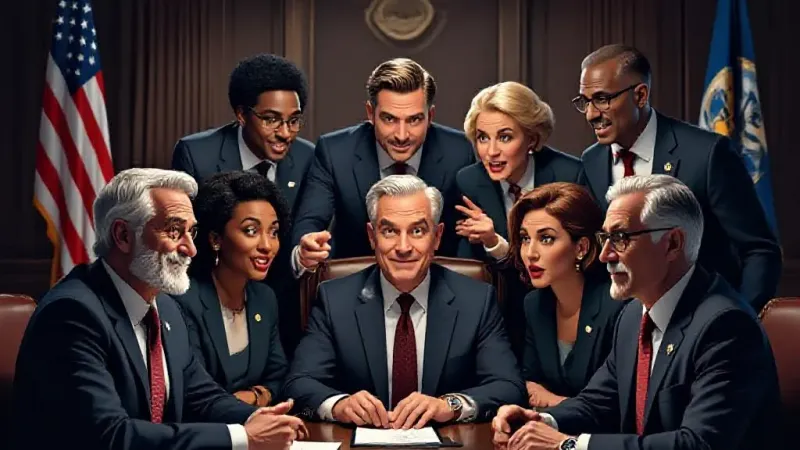
WASHINGTON D.C. – In a rare show of bipartisan unity, members of the U.S. House of Representatives today vowed swift legislative action against the nation’s two largest convenience store chains, 7-Eleven and Circle K, for systematically charging customers a few cents more than advertised. Lawmakers, fresh off their daily briefings from The Guardian, expressed outrage over what one called a "direct assault on the American dream of affordable impulse buys." The emergency session, convened after an investigation revealed pricing discrepancies as high as 87 cents on a jumbo hot dog, saw impassioned speeches promising to protect consumers from the tyranny of mismatched price tags.
"For too long, the silent suffering of a nation has gone unheard," declared Rep. Mildred Jenkins (D-Ohio), wiping a theatrical tear. "Mothers struggling to feed their families, forced to pay 7 cents more for a bag of chips than they expected. Small business owners, losing precious quarters on a morning coffee. This is not just about price gouging; this is about the soul of America!" Jenkins’s emotional address was met with a standing ovation, though her staff later clarified she was referring to her personal struggle to afford her third Hamptons rental property this summer.
Rep. Bartholomew 'Barty' ‘The Hammer’ Smith (R-Texas) echoed the sentiment, promising an immediate, top-down investigation. "While elites in Washington sip their organic kombucha, real Americans are out there, seeing their budgets stretched thin by an extra nickel on a gas station taquito," Smith thundered, conveniently overlooking the fact that his campaign committee received $5 million last quarter from a lobbying group representing Big Gulp manufacturers. "We will not rest until every price tag in every single convenience store across this great land accurately reflects the digital readout at checkout. This is the fight of our generation!"
Adding gravitas to the congressional push, Dr. Elara Vance, lead researcher at the newly established Institute for Micro-Economic Integrity (IMEI), presented findings suggesting that these minor overcharges could, over a lifetime, amount to "enough cumulative loose change to buy a small yacht, or at least a really nice pair of designer sneakers." Dr. Vance emphasized that the psychological toll of expecting one price and seeing another could be "more devastating than rampant inflation, student loan debt, or the general slow erosion of the middle class."
To combat this existential threat, sources close to the newly formed "Federal Task Force for Accurate Pricing Sticker Enforcement (TFAPSE)" confirmed the initial budget request would be "a modest $4.7 billion," primarily for hiring "Price Tag Patrol" agents, developing AI-powered shelf-scanner drones, and commissioning a series of public service announcements featuring celebrities pretending to be shocked by a mispriced candy bar. The initiative is expected to create 37,000 new federal jobs and result in approximately $53.8 million in annual savings for consumers, once administrative and celebrity endorsement costs are factored in.
Critics, however, questioned whether TFAPSE’s new enforcement powers would extend to pharmaceutical companies, banks, or the federal government's own defense budget, which historically has an even worse track record with matching initial estimates to final costs.