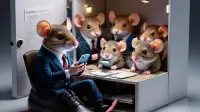
A groundbreaking study, bankrolled entirely by a consortium of major corporations, has officially linked remote work to a concerning condition identified as "unsupervised employee autonomy" (UEA), characterized by "dangerous levels of personal well-being" and "unaccounted-for moments of genuine happiness." The findings, released today by the newly formed Institute for Workplace Oversight and Shareholder Value, strongly recommend an immediate, mandatory return to traditional office environments to mitigate these alarming health disadvantages.
"Our comprehensive analysis clearly indicates that when employees are not under direct, constant surveillance, they tend to experience an unnatural surge in 'personal time' and 'unfettered thought processes,' which can severely disrupt established corporate metrics," stated Dr. Brenda Vance, lead researcher and former Head of Employee Engagement Optimization at OmniCorp. "The data points to a disturbing correlation between access to natural light and 'distracted productivity,' and we’ve even found anecdotal evidence of home-cooked meals leading to 'subversive energy levels' that undermine scheduled break times and encourage independent thought."
The study further highlights the profound "health benefits" of fluorescent lighting, stale office air, and the invigorating stress of a morning commute, all of which are mysteriously absent in remote settings. According to the research, the consistent, low-level anxiety produced by open-plan offices, the strategic deployment of passive-aggressive post-it notes, and the constant hum of a perfectly climate-controlled cubicle farm are crucial for maintaining an optimal state of "performance-ready hyper-vigilance." Without these critical environmental factors, employees risk developing "unproductive contentment," a state where they might, for instance, enjoy their work or, even worse, their personal lives and families.
"It's not just about what they're doing; it's what they're *not* doing," explained Chad "The Closer" Bronson, a VP of Human Capital Re-alignment at Synergistic Solutions Inc., who was not involved in the study but "applauds its bravery." "When workers aren't experiencing the subtle, motivating discomfort of a poorly adjusted office chair or the psychological rigor of battling for a shared fridge space, they lose their competitive edge. These are the vital micro-stressors that forge resilient, compliant team players. Remote work simply deprives them of this essential corporate boot camp."
In response to these dire warnings, several companies have already announced aggressive return-to-office mandates, citing their unwavering commitment to employee "holistic corporate wellness." These initiatives include new "mandatory communal coffee-break" policies to ensure maximum social friction, and "desk-based mindfulness modules" designed to redirect any stray thoughts back to quarterly objectives. Any employee found engaging in "excessive personal optimization" or "unauthorized domestic tranquility" while working remotely will be offered remedial office re-integration sessions.
Ultimately, the Institute for Workplace Oversight and Shareholder Value concludes that the healthiest employee is one whose every waking moment—and perhaps even a few dreaming ones—is dedicated solely to enhancing shareholder value. Anything less is, quite simply, an unacceptable health hazard to the company and its bottom line.