
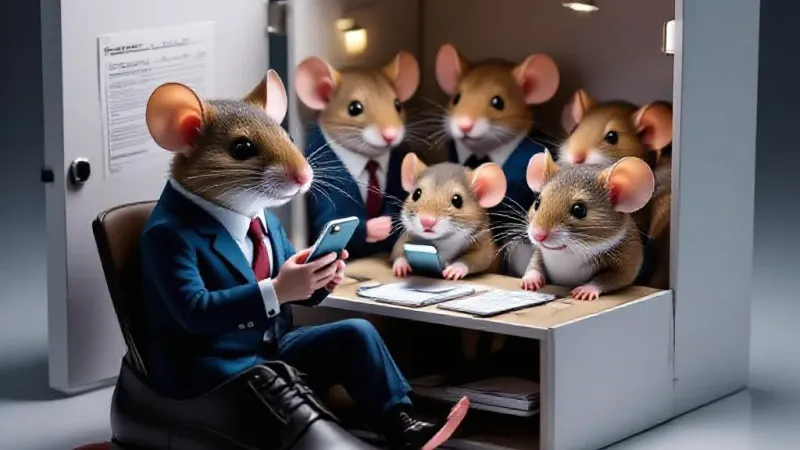
LOS ANGELES – In a landmark study published today, scientists at the Institute for Aspirational Proximity Studies announced a breakthrough in neurological research: the successful integration of human brain organoids into lab mice. While the stated goal was to understand human brain disorders, researchers were reportedly startled when the modified rodents immediately began exhibiting an uncanny grasp of contemporary socio-economic anxieties, organizing for better work-life balance, and forming highly opinionated online communities.
“We expected to see neuronal activity related to, you know, Parkinson’s or Alzheimer’s,” stated lead researcher Dr. Brenda Finch, wiping sweat from her brow. “Instead, Subject 7 began meticulously tracking its nest’s Zillow estimates, Subject 3 tried to pitch us a crypto startup, and the entire cohort of twenty-four mice collectively threatened to unionize if their pellet dispenser wasn’t upgraded to a 'wellness-focused, sustainable foraging experience' with hybrid options. We’re still not sure what 'hybrid options' means for a mouse in a cage, but they seem very firm on it.”
Further observations revealed a rapid adoption of human cultural touchstones. Within 48 hours, the mice had established a complex social hierarchy based on follower counts on a nascent platform called "Mousetok," where they posted short videos of themselves meticulously cleaning their whiskers while lip-syncing to pop songs and complaining about the predatory pricing of artisanal cheese. Several mice were reportedly seen openly weeping while watching ads for luxury cars, others developed an inexplicable craving for oat milk lattes, and one particularly vocal specimen demanded to know why its 'wellness journey' wasn't gaining more traction.
A spokesperson for BioGenCorp, the primary funder, quickly issued a statement attempting to pivot the narrative. "This groundbreaking research unequivocally demonstrates the human brain’s incredible capacity for... *adaptability*," the statement read, avoiding eye contact with a mouse holding a tiny picket sign that read "NO MORE UNPAID SCRUTINY." "We believe these models will provide unprecedented insights into the human condition, helping us understand the neurological underpinnings of... *motivation* and *resource allocation* in rapidly changing environments."
The project, originally intended to cure human suffering, has instead confirmed that suffering is just the default setting, now available to all species with sufficient cortical density and access to Wi-Fi.