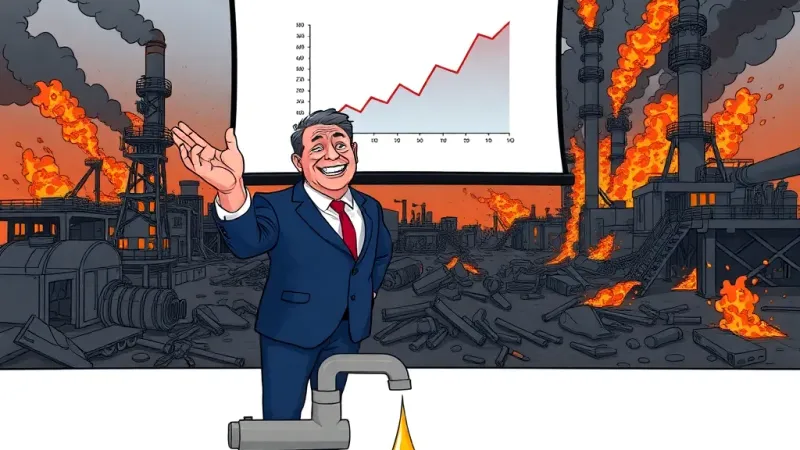
GEELONG, VIC — Viva Energy Group Ltd. yesterday declared its Geelong refinery is poised to achieve an impressive 90% of its previous operational capacity within weeks, hailing the significant recovery as a testament to its resilience following a recent ‘unplanned thermal management incident.’ The company, whose shares subsequently fell 5% on the ASX, characterized the near-full output as an 'optimally efficient new normal' for the facility.
“We are absolutely thrilled to report that, after what we are formally classifying as a temporary structural recalibration, our Geelong facility will soon be producing 90% of critical fuels,” stated Ms. Brenda Lumina, Head of Proactive Stakeholder Reassurance for Viva Energy. “This represents a staggering 90% improvement over the immediate post-recalibration output, demonstrating our unwavering commitment to supplying Australia with most of the diesel, jet fuel, and gasoline it requires. We view the remaining 10% as a strategic reserve of potential future capacity, a sort of financial safety buffer for our shareholders, should they ever need to process less.”
Industry analysts, however, noted the curious mathematical implications of the announcement. “While 90% is indeed a number, and certainly higher than zero, it is also demonstrably lower than 100%,” commented Dr. Julian Thorne, Senior Infrastructure Efficiency Consultant at Global Insight Pty. Ltd. “The market seems to be grappling with the innovative corporate messaging that implies a reduction in capacity is, in fact, an achievement worthy of celebration. It’s an interesting philosophical debate: Is a glass 90% full, or 10% less than full after you’ve accidentally shattered a significant portion of it?”
The company emphasized that new, cutting-edge safety protocols have been implemented, including a mandatory five-minute ‘think about fire safety’ break before each shift and a 30% increase in the number of designated 'evacuation corridor awareness officers.' Local officials expressed a cautious optimism, with Geelong Mayor Carol Jenkins stating, “We are just glad to hear they’re doing something, whatever that 90% actually means for the local economy and air quality.”
Viva Energy concluded its statement by reassuring customers that the slight reduction in output would be imperceptible to anyone not actively counting molecules or experiencing a shortage.