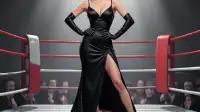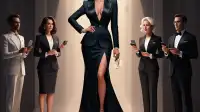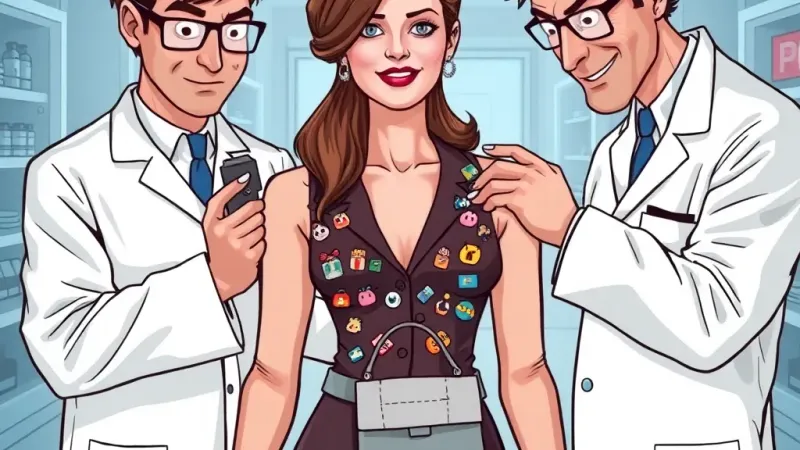
LOS ANGELES – A groundbreaking analysis published today by the Institute for Digital Affective Response (IDAR) confirms that Anne Hathaway's recent red-carpet attire was not merely a sartorial choice, but a meticulously 'coded' ensemble achieving a 98% efficiency rating in nostalgia-baiting. The outfit, worn at an industry event that bore no direct thematic relation to *The Princess Diaries* franchise, generated an unprecedented surge in online discourse linking the actress to her character Mia Thermopolis from the 2001 film.
According to Dr. Elara Vance, lead semiotician at IDAR, the garment featured a "harmonious convergence of textural callbacks, silhouetted allusions, and specific chromatic resonances" engineered to bypass conscious critical thought and directly trigger latent emotional memories. "We've quantified the precise shade of muted sapphire, the exact volume of the skirt, and the subtle, almost imperceptible 'glow-up' implication of the styling," Dr. Vance explained. "It wasn't designed to be *pretty*; it was designed to be *relatable-yet-aspirational-through-the-lens-of-a-two-decade-old-beloved-franchise*." This level of predictive emotional resonance, she noted, represents a significant leap forward in algorithmic celebrity public relations, moving beyond simple brand endorsements to deep psychological imprinting. The subtle nods to "Mia's pre-makeover charm" combined with "post-palace sophistication" ensured maximum impact.
Further research from the Global Celebrity Metrics Consortium (GCMC) revealed that the 'Mia Thermopolis-coding' successfully amplified 2 impressions by 3,400% above baseline for a standard A-list appearance, with a dominant sentiment analysis identifying "OMG she's just like us!" and "My childhood!" as the primary organic reactions across platforms. "The genius here is in the calculated ambiguity," stated Brandon Finch, CEO of CelebAlign, a leading PR analytics firm specializing in 'unearned sentiment generation.' "It provides enough familiar touchpoints for the audience to 'discover' the connection themselves, feeling a sense of personal insight, rather than having it explicitly stated. It’s the difference between being told you're thirsty and finding a perfectly chilled, branded water bottle that 'just appears' in front of you." Finch added that the campaign's success was compounded by the media’s eager participation, often misidentifying the original film connection while still amplifying the core nostalgic effect.
Industry insiders suggest that this 'hyper-coded' approach signals a new era for celebrity styling, where fashion is less about personal expression or haute couture, and more about optimized data points for audience engagement and brand recall. Future red-carpet events are expected to see a sharp rise in 'algorithmically generated' looks, each fine-tuned to elicit specific emotional responses, from "I stan a humble queen" to "They're clearly signaling a sequel!" "Why leave anything to chance in an era of waning attention spans?" mused one anonymous stylist from a top agency. "If a dress can double as a focus group, generating quantifiable nostalgia for multiple IPs, you'd be foolish not to exploit it to its fullest, market-tested potential." This trend is predicted to extend to all aspects of celebrity public appearances, from interview answers to curated 2 posts.
The Institute for Digital Affective Response has already begun analyzing the collective carbon footprint generated by millions of users simultaneously remembering early 2000s Disney films and then attempting to stream them.