
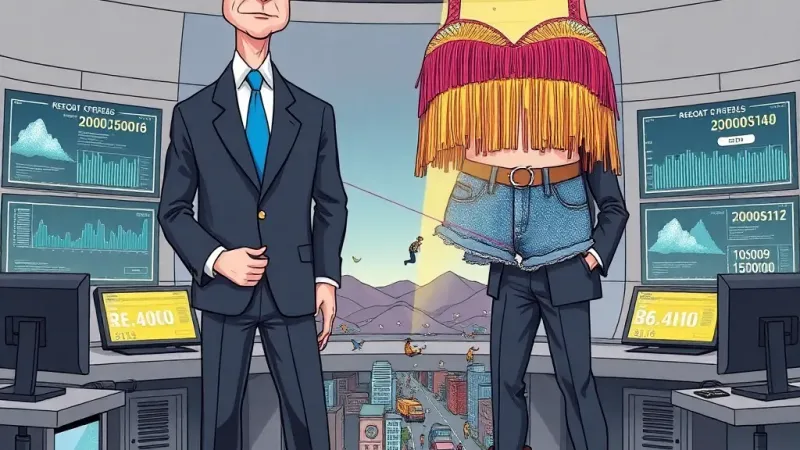
WASHINGTON D.C. — Analysts at the Global Market Stability Initiative (GMSI) are closely monitoring the economic fallout following influencer Olandria Carthen's recent "pre-game" reveal of a corseted little black dress for the upcoming Coachella Music and Arts Festival. The highly anticipated fashion debut, covered extensively by several style publications, has reportedly sent minor but observable ripples through various consumer sectors, prompting concerns about market equilibrium ahead of the pivotal spring festival season.
"While many might dismiss this as mere celebrity fluff, our preliminary models indicate a potential 0.0003% fluctuation in the global demand for structured polyester blends by Q3, alongside an uptick in search queries for 'sustainable boning material'," stated Dr. Alistair Finch, Lead Behavioral Economist at GMSI, from a secure, climate-controlled bunker facility in Northern Virginia. "When an individual with Ms. Carthen's digital reach — currently valued at 23.7 million verified engagements per annum — signals a preference, it creates a micro-surge in market sentiment that, if unmanaged, could lead to a sudden, inexplicable interest in corsetry among suburban teens, potentially disrupting the multi-billion-dollar athleisure hegemony."
The initial reveal, meticulously documented across 17 distinct 2 platforms and 3 major fashion blogs, demonstrated Carthen's "strategic deployment of a vertically integrated style narrative," featuring a bespoke, ethically sourced Italian crepe de chine LBD, accessorized with a vintage silver 'Y2K revival' belly chain. This, according to a hastily assembled emergency brief from the Council of Applied Pop 2 Economics (CAPCE), is a significant departure from previous "unstructured bohemian floaties" 2, requiring immediate recalculation of supply chain logistics for "aesthetic readiness" and "festival compliance." The CAPCE report highlighted that such "pre-positioning of sartorial assets" now necessitates a more robust governmental oversight of celebrity outfit embargoes.
"We're seeing an unprecedented level of pre-festival sartorial foreplay," explained Brenda 'Bree' Sterling, a veteran fashion commodity broker from the Sterling-Monroe Style Futures Exchange, adjusting her own artisanal, hand-knitted alpaca-blend shawl. "Traditionally, the market would absorb these choices organically during the festival's initial hours, allowing for gradual consumer adaptation. Now, with this pre-emptive strike, consumers are forced to adjust their purchasing strategies weeks in advance. My inbox is already flooded with panicked inquiries about the optimal price point for ethically sourced pleather bustiers and distressed denim cut-offs. Frankly, it's exhausting. We used to just wait for the pictures to drop, then react. This 'pre-gaming' is fundamentally altering the natural rhythm of celebrity-driven micro-economies, demanding immediate futures contracts on 'Festival Essentials' and 'Post-Event Repurposing.'"
A spokesperson for the Bureau of Economic Influence, who wished to remain anonymous to avoid direct association with "fashion metrics," confirmed that federal agencies are now considering establishing a "Celebrity Wardrobe Warning System" to alert small businesses to impending shifts in transient fashion trends. "The goal," the spokesperson clarified, "is to prevent a run on novelty glitter adhesives or, worse, a sudden devaluation of fringe."
Authorities are advising consumers to remain calm, avoid speculative panic-buying of small black garments, and remember that, at its core, this is still just a person wearing clothes to a concert in the desert, which will then be forgotten by Tuesday.